Site Navigation

Showing posts with label article. Show all posts

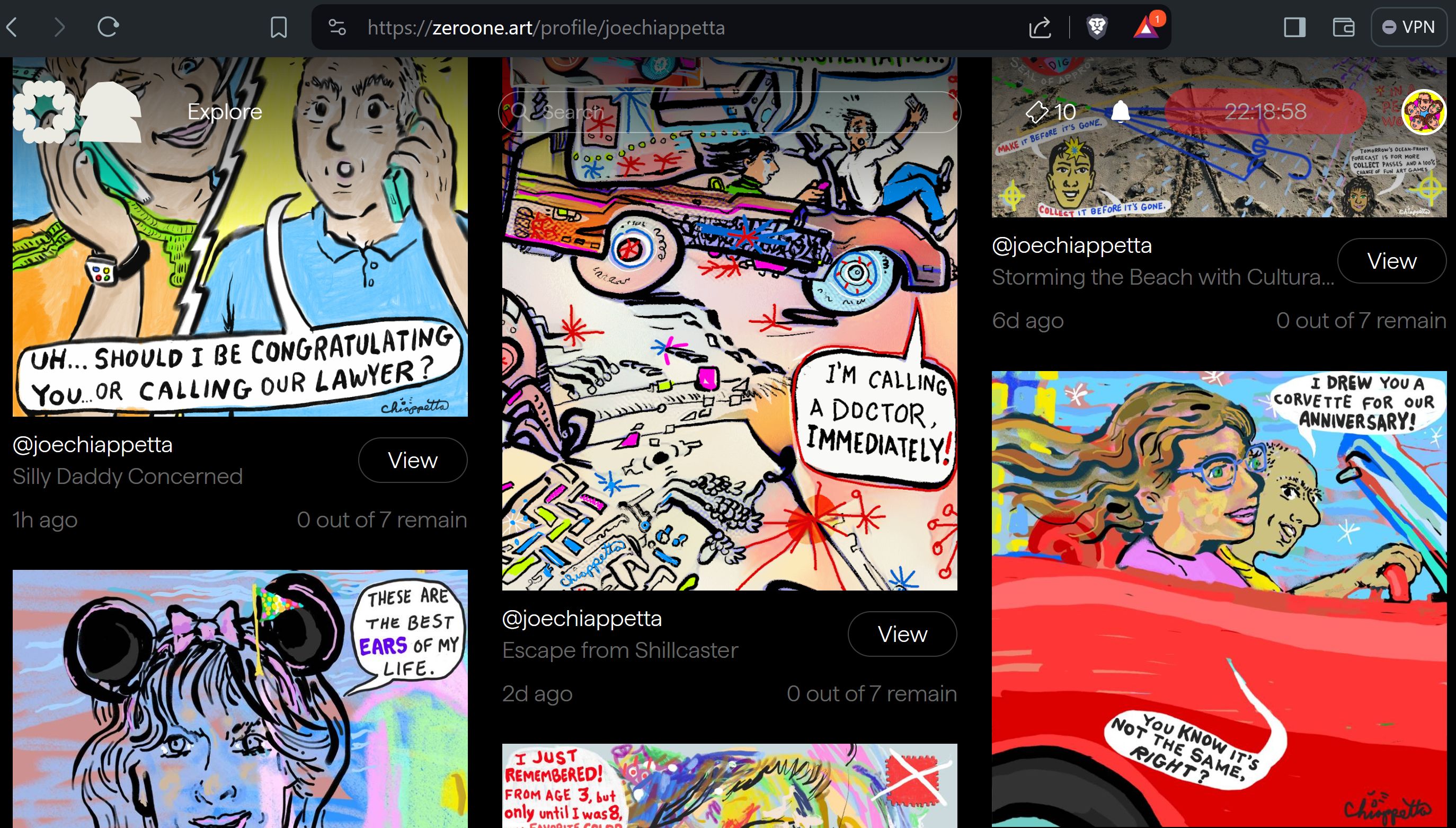
Why I Released 50 NFT Comics on zeroone

zeroone art profile page for Joe Chiappetta

Having spent the past 3 decades releasing art on the Internet, it would be an understatement to say that I have tried more than a few different art-related platforms over the years. For most of these websites, they offered timely tools for art marketplace access, publicity, sharing, and exploration. The art site I now prefer, "zeroone," has all that and so much more. As an incredibly visionary art site I have used almost exclusively for the past 10 months, zeroone also offers art ownership, gifting, and gamification. I could probably write pages of reasons why I appreciate the site, yet for the sake of brevity, here are the top 5 reasons I have spent nearly a year releasing 53 original comic NFTs on zeroone while also collecting nearly 500 art NFTs:

1. zeroone is THE place to collect original art NFTs where each person uses their own art as "currency" to gain collector passes. For every piece you release through zeroone's site, you can collect up to 10 artworks from other artists.

2. The community is typically un-snooty, easy-going, giving, and kind... which is refreshing to experience in the arts.

3. NFTs on a blockchain have historically been complicated to access, yet zeroone, running on the Avalanche blockchain, has made the NFT art collecting and releasing process ridiculously easy, quick, and free. This holds untapped potential for creative-minded people and institutions such as libraries, museums, schools, and galleries to start archiving their special collections on the blockchain where provenance is built into the platform.

4. While so much of the art world has a greed-mentality ingrained into its fabric, zeroone has a giving-mentality baked in. The only way to receive any art there is to give art.

5. zeroone is one of the rare places that has successfully turned NFT art-releasing and art-collecting into a game of sorts. It's fun and surprising to check the site and see if I'm in time to collect from one of my favorite artist's work there before all their editions run out--or before my collect passes run out. This game of art never seems to end--spurring me on to make and mint even more art in a festival of giving!

Play it with me and my son at https://zeroone.art/profile/joechiappetta and https://zeroone.art/profile/lukechiappetta

World's Fair of Rare Digital Art

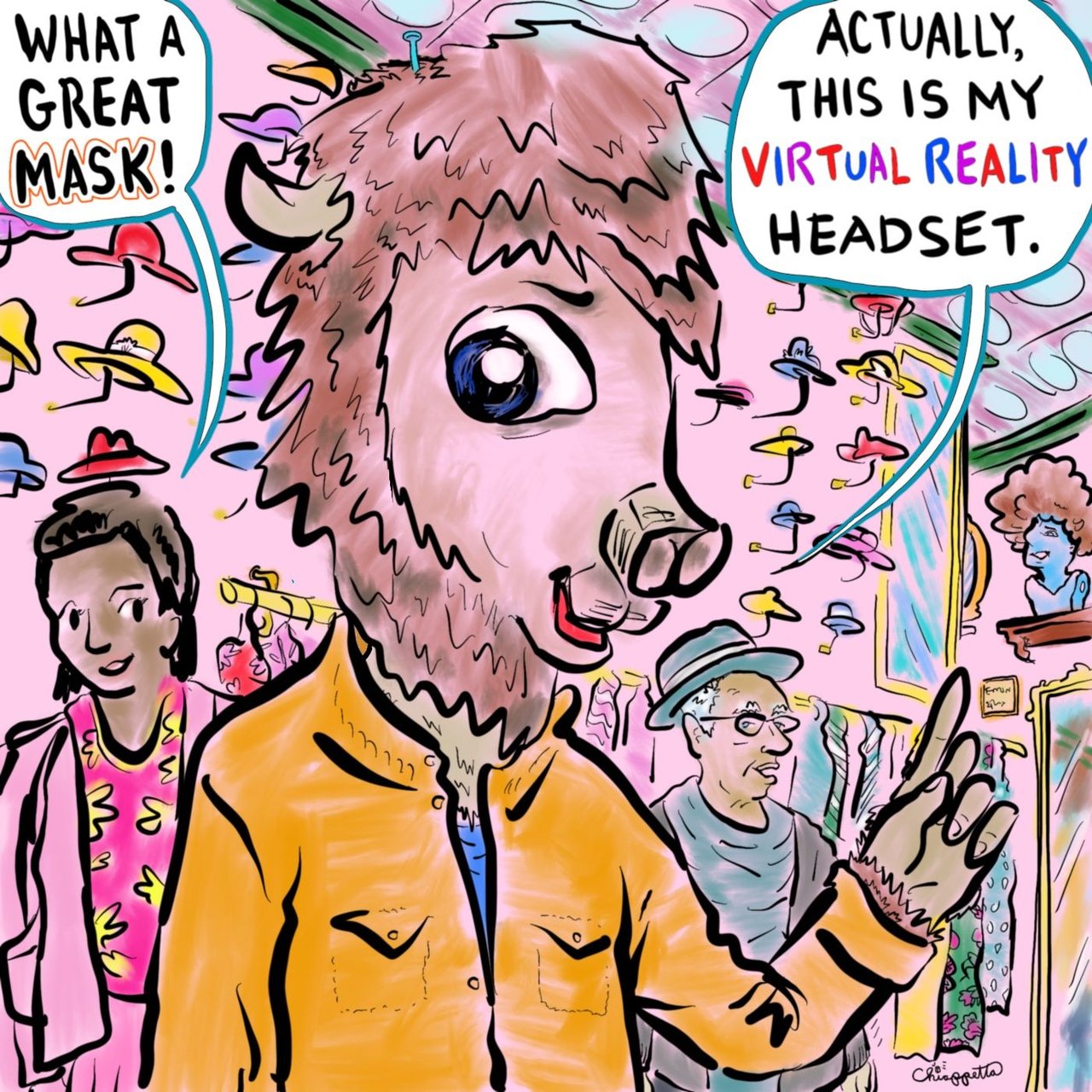
Where the Buffalo Browse is rare digital art by Joe Chiappetta
Where the Buffalo Browse is rare digital art by Joe Chiappetta, available on Atomic Hub Marketplace. While this cartoon pokes fun at virtual reality culture, behind the fun just might be an economic revival for the art industry--the likes of which has never been seen--at least not while wearing a buffalo helmet.

World's Fair of Rare Digital Art:

Digital Art Needs a Multidimensional Digital World

Joe Chiappetta, February 2021

When virtual reality (VR) becomes user-friendly, affordable, with universal technical standards integrated from online gallery to gallery, the art-loving world could see a revival more influential even than the Italian Renaissance. Indeed, everyone (with internet access) could witness this World's Fair of Online Art, open 24-7, poised to impress and built to buy/sell rare digital art as if you were floating through a game-like world because... well... because you would indeed be floating through a game-like world--virtually speaking. Such a place would have free admission for all, economic opportunity for all, and operate in 4 virtual dimensions of height, width, depth, and the dimension of "Wow, this is awesome!"

Of course, online 3-D digital worlds are nothing new, as any player of Minecraft or Second Life will tell you. Neither is cryptocurrency a new thing. In fact, all 3 of these systems have been operational for over 10 years. Yet what would happen if a 3-D digital world were well-integrated with digital art, community equality, and cryptocurrency? It could become the art industry's "killer app."
Silly Daddy VR Helmet is rare digital art by Joe Chiappetta
Silly Daddy VR Helmet is rare digital art by Joe Chiappetta, available on Atomic Hub
At 64 billion dollars for 2019, the global art market saw a decline in sales from the previous year. While 2020 statistics are not compiled yet, it is likely that this figure will be even lower. With fast transactions and borderless payment power, some are scrambling to declare cryptocurrency as the soon-to-be savior of a slumping global art market. 

However, the truth is at least a little more complex. Made possible by cryptocurrency, a small but excited number of people do collect rare digital art. But most in the art world still have no idea what such terms really mean.

What is rare digital art? It's online creative work tied to cryptocurrency that has been released in limited quantities, verifiable on a blockchain. For those in need of a refresher on what cryptocurrency is, think of it as coded internet money or credits released (usually) by entrepreneurs in specific predefined amounts. I should know; I have been researching and writing about this space for many years. In fact, I'm one of those rare digital art collectors. Many know that I am also a pretty prolific rare digital artist and educator in this space as well.

If you are just joining the rare digital art industry now, don't think you are late to the party. While rare digital art is 6 years old, the earliest pioneering developments from 2014 were not widely publicized and very slow in adoption (running on top of Bitcoin, often using Counterparty). Indeed, the first 4 years of rare digital art went by without much notice. Even now, the mainstream art world remains quite slow to completely jump on the bandwagon. So we are still in the very early days of rare digital art! For example, the Italian Renaissance lasted about 200 years, and some art historians find traces of the Renaissance roughly 100 years prior to its start through the work of Giotto. 

Whether the Italian Renaissance lasted 200 or 300 years, is not the point. Rather, it is significant that when a new movement starts, the early years of that movement are never as defined as historians make them out to be. Therefore if you are in rare digital art now, congratulations, fellow pioneer! You will be one of the early ones to help define and further shape it.

Since we are the early adopters, the question at hand is "Where do we go from here?" The first step is to soberly see where we really are now. The practice of buying rare digital art is only slowly being adopted by mainstream art collectors, and much of the rare digital art industry is dominated by speculators looking to make a quick profit flipping art. 

As an old-school physical collector turned rare digital art collector, I am not a flipper or speculator. In fact, of the many rare digital artworks in my collection, I rarely sell pieces from my collection. That is because I acquired the art in the first place because I wanted it for the fun of it. The art spoke to me in a unique way and simply made me happy. So if I can add such a piece to my collection, I will, and not worry about whether or not I can make money off of it later.
Zine Machine is rare digital art by Joe Chiappetta
Zine Machine is rare digital art by Joe Chiappetta, available on Atomic Hub.
By contrast, I do sell a nice amount of my own original artworks. That has been a practice of mine in the physical world (since the 1990s at comic book conventions) as well as in the digital world on rare digital art markets. While (literally by the grace of God) I have collectively sold hundreds of pieces of rare digital art on Ethereum Network, SuperRare, Atomic Hub, and Book of Orbs. I can't say the same for everyone. Indeed, the opposite is true; the majority of artists--despite their great talent--are not selling much.

Unlike myself, not everyone has the benefit of 4 decades experience in the arts as well as authoring one of the longest running autobiographical comics about family like I have with Silly Daddy Comics and Silly Daddy Zine. Most folks are just starting out as artists, or are really strapped for time working odd jobs and doing art on the side. Therefore, people can't be wasting time on markets where they may never sell anything. Everyone's time is valuable. So it is important, as we shape the rare digital art economy, that we build more opportunity in it--not just for the superstars, but for everyone.
Loyal Daddy is rare digital art by Joe Chiappetta
Loyal Daddy is rare digital art by Joe Chiappetta, available on Atomic Hub.
Despite the challenges of emerging artists struggling to make significant impact, artists are flocking to release new works on rare digital art markets in ever-increasing numbers. Naturally, due to the sad difference between supply and demand, as I alluded to previously, most of these artists will not sell anything there, and will soon leave the market discouraged. Some, in bitterness, may even spread a bad report about the true innovation going on in this still growing space, but don't be deceived; the best is still yet to come!

Next Steps for Rare Digital Art Markets

So what's the solution to increase demand for this kind of art? A higher quantity of serious art collectors will need a number of good reasons to jump into the rare digital art market. That's because the experience of collecting most digital art (rare or otherwise) is often--for lack of a better term--anticlimactic. It is hardly a social activity since collectors typically buy their art alone on their computers--with absolutely no fanfare. I know this because that is what I do as an art collector. 

Aside from the excitement of in-person rare digital art auctions, which are few and far between, why does collecting rare digital art hover on the sometimes anticlimactic side? It is actually a design problem. For most web sites selling rare digital art, the pieces are almost always offered in a visually dull grid layout. This is basically a 2-D catalog experience. Such design conventions have not changed since the mail order days which showcased department store catalogs of centuries gone by. That's not much different than scrolling through an Instagram art feed. Things really must change, and they can.

Gratefully, we have the technology to make those changes now. Online galleries who move to a virtual 3-D exhibit experience can be the ones who can stay relevant in an increasingly digital world.  As art-seeking and collecting becomes more of a game environment, more people will get excited about it.

The WAX community, and in particular the Atomic Hub Marketplace, is doing an incredible job at making 2-D rare digital art galleries fun, gamified, and incredibly user friendly. In fact, Atomic Hub has a "bundle" feature that allows collectors to buy multiple pieces of art in the same transaction. I liken it to the coolness and excitement of being a kid and buying a pack of trading cards. 

Digital Art Needs a Multidimensional Digital World by Joe Chiappetta is rare digital art available on MakersPlace
Digital Art Needs a Multidimensional Digital World by Joe Chiappetta. It's rare digital art available on Ethereum Network.
Another example of innovation is the unlockable content feature for owners of rare digital art. OpenSea and a growing number of other rare digital art markets have this feature. I used this feature to release my newest book, Silly Daddy Zine #1. Here's how it works: everyone can just see the cover of the book. But only those who buy it as rare digital art gain access to download the 50 page book. This unlockable download for owners is one of the most exciting new features in the industry, providing more incentive for further adoption.
Silly Daddy Zine 1 book cover by Joe Chiappetta
Silly Daddy Zine #1 is rare digital art and a 50-page book by Joe Chiappetta, available on Ethereum Network.

Looking to the future, the next bold step is to migrate the best of these current rare digital art markets, like OpenSea and Atomic Hub, onto one virtual 3-D world that is only somewhat similar to Minecraft, Decentraland, Cryptovoxels, or Somnium Space. I say "only somewhat similar to..." because none of those sites have all of the below essential features:

VR Art Gallery Essentials

  1. Exhibitors earn the rights to virtual 3-D land and wall space by purchasing affordable rare digital art in this world.
  2. The virtual 3-D land to have gallery space will always be cheap and not manipulated by early speculators trying to drive up the price of land.
  3. The virtual land borders keep expanding as more users exhibit in the space. Like the internet, where users can make an unlimited amount of new web pages, the same goes for wall and land space. More gets created as more is needed.
  4. Collectors can explore, exhibit their collections, and still buy and sell art all in a 3-D realm.
  5. The virtual 3-D gallery can be explored without a VR headset, plus users can buy and sell art without a headset too.
  6. The virtual 3-D gallery world has a 2-D auto-generated counterpart for those with slower technology.
  7. The 3-D world and its members have a code of conduct that adheres to the moral standard outlined in the FCC's guidelines and is a kid-friendly environment.
  8. Users can create individualized exhibit space right in the 3-D environment without any coding knowledge. All necessary virtual building materials are available for free.
  9. A few non-essential, yet more flashy premium gallery building materials are earned by those who buy a high volume of rare digital art, or complete defined and helpful tasks to advance the community.
  10. Users can teleport to any location in the "world" quickly and easily. These links work in-world and also as links on a regular website.
  11. Users can customize their own avatars.
  12. The gallery does not issue its own new cryptocurrency, but rather leverages existing and widely adopted currencies. The art and art experience is the product, not another alt-coin.
  13. Transactions to buy and sell art in the 3-D virtual environment can be done via credit card, PayPal, or existing crypto such as Bitcoin, Ethereum, EOS, and WAX. These cryptocurrencies are mentioned as they all have an existing and established track record of being used in current art markets. By default, financial actions on the site should be using blockchains that have no transaction fees to use the network.
  14. No sign-in is needed to view and explore this world.
  15. Open standards are used to foster as much continued development and international collaboration as possible. Perhaps Blockchain Game Alliance can help make this happen since they are a diverse professional coalition from a variety of blockchain and gaming platforms.
  16. The environment also has 3-D games that a user can play--kind of like walking through a carnival; there's a game booth, and next to it is an art booth, including a collaborative VR drawing space, like a VR version of Dada.art. Prizes won in the game booth can include rare digital art. As an added example, imagine being able to play a great rare digital art shooter game called Spells of Genesis in a multiplayer 3-D universe and receive game points, crypto, or rare digital art as your winnings!
  17. This VR cryptoart world should also have built-in user-to-user messaging (perhaps through secure chat), audio capabilities, and parental controls.
  18. Designed as an ever-expanding World's Fair of Online Art, collectors can seamlessly use their avatars to explore a 3-D version of contemporary high-end Expressionist art from various galleries on one virtual block, perhaps on a street called Emotional Way. Then they would turn a corner and walk down Budget-Buy Boulevard, where all rare digital art is no more expensive than a bottle of water.
  19. Such a site should also have a daily virtual newspaper, which aggregates relevant art news from this realm and sends it to members who subscribe. This would be things like how many new pieces of art were sold, created, who collects the most art, who releases the most art, who sells the most art, who has spent a lot of time on the site yet is not receiving many gallery visitors, who refers the most new users to the site through a referral code... kind of like a game leader board, but also designed to help everyone.
  20. Site should have the ability for creators to upload new rare digital art of their own creation to be displayed on exhibit space owned by the artist. The operators of the site would take a commission on these sales and artist would receive the bulk of the sales. The artist could also receive a percentage of the resale commission on all secondary market sales if made via blockchain through the platform.
While it must be acknowledged that some VR art galleries are already operational (and have been for years), most just feature artists creating VR experiences as an isolated piece, not other kinds of art, and not connected to a whole VR world. Additionally, few of these galleries use cryptocurrency, none of them are household names, and they're all fragmented realms. More importantly, none of the existing sites have even a fraction of the features numbered above. Yet this is what is needed for wide consumer adoption.

That's not to say that existing VR galleries are failing or prospering; the data on that is not easily available (or reliable). Yet like the rest of the art world, these sites are typically siloed, many requiring expensive hardware to view (while this same hardware will be obsolete in a few years), and most of the existing VR galleries are hustling to make an individual name for themselves. There's nothing wrong with hustling to self-promote, but much effort must also be spent on collaborating to build a unified virtual art fair experience.

Consider this analogy as the current state of VR art galleries: disconnected food trucks with delicious food, yet non-uniform procedures exist at random, hard to find parking lots, while what is really required is a cohesive international full service food court. A combination of the above-listed elements could create a very compelling art environment that would be unprecedented, and perhaps even become the "Ready Player One" artistic universe of tomorrow... yet live in our own time. It would inspire many repeat customers, delighted to explore a dynamic virtual art market in an exciting and gamified role as art collectors, art-seekers, and new art pioneers.

Joe Chiappetta
http://SillyDaddy.net

What Makes Great Rare Digital Art?

In a strange new world of blockchain kicks and crypto culture clash, one man stands poised to sort it out for the greater good.
Rare Digital Art Man by Joe Chiappetta

Rare Digital Art Man by Joe Chiappetta will soon be released as rare digital art in the pixEOS Gallery.

Along with a tribe of talented developers and entrepreneurs, I am part of a team that will soon be launching a rare digital art gallery on the EOS blockchain. It is called The Grand pixEOS Art Gallery. This will be a marketplace where creators of art can monetize their original artwork through a process called tokenization. That means an artist creates unique artwork and through the pixEOS market, uploads it to an online blockchain art gallery to be sold in exchange for cryptocurrency: in the case of the pixEOS gallery, artist will choose to sell their art in exchange for EOS tokens or PIXEOS tokens.

What art collectors actually buy when selecting rare digital art to collect is a unique cryptocurrency token that is specifically tied to that art image and can be resold on the blockchain and traded as determined by one owner at a time. Limited edition pieces can also be released, so prior to publication, each creator chooses whether to sell the art as a super rare edition of only 1 or in limited editions, such as 5 or 10 copies. Ownership and scarcity is uniquely verifiable on the blockchain.

This is a new movement in the arts that goes by a few different names: rare digital art, non-fungible tokens (NFTs), and crypto-goods. On the Ethereum blockchain, my favorite marketplaces/communities to issue and collect rare digital art have already been up and running for over a year: MakersPlace and SuperRare. I am very active in those communities and have made good friends there too. EOS is a newer blockchain, and after over a year of development, the EOS community will also soon have the ability to participate in a similar full service professional rare digital art gallery experience.

In creating such a marketplace/gallery for rare digital art on the EOS blockchain, the community (of course) wants the art therein to be great--or at least really good and highly collectible. Yet there is no singular definition of great art; there never will be. The vast international and cultural diversity in the art community will ensure that not everyone will agree on what is great, or even appropriate. As the old saying goes, "beauty is in the eye of the beholder."

Nevertheless, I do have in mind what I am looking for in the arts; I want to create a safe, inspiring place where people of all ages can appreciate and collect art without fear of harm or offense. Think of it as an inspiring shelter from the storm of life. Imagine a gallery where you can browse art with your young kids as well as your conservative grandmother and be continuously uplifted. I always appreciate the succinct and noble goal stated in Epidemics, an ancient Greek medical text: "to do good or to do no harm."

Doing good and/or not being harmful is a guiding principle I use in life, and it is also central to how curating art in the pixEOS Gallery will operate. I also believe that such a principle is at the core of what makes for really great, timeless art. To outline this further, below are a few practicals that support such a view of greatness, specifically in this new world of rare digital art. I encourage creators to use this list as a starting point as they assess which works they should (and should not) release as rare digital art.

Recipe for Great Rare Digital Art

  1. Art that you would actually spend your own money on if you were a budget-conscious collector.
  2. Art that is one of your best pieces if you had to pick your top ten pieces you ever completed.
  3. Art that is professionally photographed or scanned (as opposed to a dimly lit pencil drawing taken by a weak cell phone camera where the paper edges are not cropped properly and the white of the page shows up as medium gray tones).
  4. Art that is at least 1500 pixels wide.
  5. Art that is uniquely original, where no one else's copyrighted characters or intellectual properties are the main focus.
  6. Art that has not been--and will not be--tokenized anywhere else.
  7. Art that complies with the law and upholds to marketplace terms of service.
  8. Art that gets people thinking deeply, is inspiring, or makes people laugh without being rude, offensive, or discriminatory.
  9. Art that does not entice people to do evil.
  10. Art that has a spirit of purity: safe for viewing by children of all ages as well as engaging to adults.
  11. Art that is accompanied by a thoughtful description and/or title.
  12. Art that provides solutions--or at least awareness--for important matters, whether global matters (like environmentalism) or local matters (like personal kindness or joy).
  13. Art that communicates truth with grace.
  14. Art you'd be glad to exhibit in your family's front room.

I am sure there are more traits to mention, but these are just some to ponder for now. Such a place of refuge and insight is where I want to collect art, as well as release artworks of my own.

Together I believe we can all go there!

Joe Chiappetta
http://SillyDaddy.net

Portrait of Alon Goren

Portrait of Alon Goren is rare digital art by Joe Chiappetta available as an edition of only 1 on MakersPlace

Portrait of Alon Goren is rare digital art by Joe Chiappetta, available as an edition of only 1 on Ethereum Network.

I drew this portrait of Alon Goren while he was speaking on a panel at the Crypto Invest Summit (CIS) in Los Angeles. Alon is a Founding Partner of Draper Goren Holm, Co-Founder of Ownera, CIS (re-branded as LA Blockchain Summit), Security Token Summit, LA Blockchain Week, and probably all sorts of other cool things. On and off the blockchain, he is definitely a fine fellow to know!

Alon's influence in the crypto space has been an entirely positive one and the world could benefit from more folks like him. The more you hear him talk, the more you realize that he is an insightful champion for tokenizing art on the blockchain and selling these digital assets as an innovative new paradigm for artists. I share his zeal to help people and bring economic opportunity to the masses, marking a bright new future. It is one of the reasons why I am very active with rare digital art markets like OpenSea, SuperRare, Dada NYC, and pixEOS.

This rising of rare digital art has already gathered impressive market momentum. In the past, digital art has not been regarded as being collectible. While digital art has existed since the 1960s, it has traditionally been very difficult to monetize or verify its provenance in an immutable manner. Yet now there are solutions to these issues and it has begun to transform the art industry. This will create a whole new economy through blockchain technology.

The rare digital art industry is barely 4 years old. While still in the very earliest stages of growth, art is now being tokenized on the blockchain, and such art is also known as non-fungible tokens (NFTs). These art tokens are traded internationally and have real-world value, representing specific artworks. Their ownership history is also recorded on the blockchain, verifying digital item authenticity and guarding against fraud/counterfeit items.

Despite the newness of this industry, some rare digital art markets have reported weekly sales over $50,000 USD for many consecutive weeks, and these numbers are growing. In fact, by 2024, online art sales are collectively forecasted to be over $9 billion annually according to a Statista study. So stick around. Things are about to get even more interesting.

Joe Chiappetta
http://SillyDaddy.net

CryptoArt Shrugged: What To Do During Rare Digital Art Technical Difficulties

CryptoArt Shrugged is rare digital art by Joe Chiappetta on MakersPlace
CryptoArt Shrugged is rare digital art by Joe Chiappetta on MakersPlace.

CryptoArt Shrugged:

What To Do During Rare Digital Art Technical Difficulties

Imagine for a moment this scenario. The most amazing art the world may ever see has just been finished, and you're its proud creator. Anxious to release your work for sale as rare digital art, you head over to your favorite online art market to launch the artwork to the public... yet... something's wrong! The marketplace is supposed to be live but it's temporarily delayed. Or other unexpected technical difficulties--with your entire preferred blockchain--make it impossible to immediately release such precious art. 

Would this now be the time to...
(a) Panic?
(b) Complain?
(c) Keep clicking buttons until your will be done?
(d) Leave this sketchy, experimental field forever?

The answer--probably--is actually (e), none of the above.

Therefore what should creators do when their preferred rare digital art gallery--in which they desperately want to release new artworks on--is having downtime or is delayed? The short answer is... something else. As with most things highly technical, new, and still evolving, proper development for mass consumption takes time and frequent revision. Rome was not built in a day.

Remember also some related facts of development.
  • The Internet was quite fragmented at its inception. In fact, many sites only worked in certain browsers. Many computers did not even have a web browser. The first web browser was created in 1990, yet it took at least 8 years before the Web Standards Project started to push for the Internet to have clear standards for web browsers.
  • While Bitcoin went live in 2009, it took another 6 years before anyone could issue rare digital art on top of Bitcoin (through Counterparty).
  • With Ethereum launching in 2015, it was not until over 2 years later that anyone could issue rare digital art through Ethereum.
  • Launched in 2018 as a faster blockchain with no transaction fees (unlike Bitcoin and Ethereum), major rare digital art markets on the EOS blockchain (such as pixEOS) will not go live until the later portion of 2019.
With these things in mind, the "urgent" feeling of disappointment or even frustration when delays bump through new technologies are--in most cases--not cause for alarm at all. It's all relative, and just a normal part of the development process. In other words, that's life; shrug it off.

Nevertheless, there is a way to make the most of such delays. Below are some useful professional actions that any artist can take when there are technical delays in publishing art through a preferred rare digital art market.

Rare Digital Art Downtime Game Plan

  1. Think of more relevant tags and text to add to your existing artwork.
  2. Re-share previously released, yet unsold art on social media.
  3. Look around the web to see if this art would be good as a new submission for a contest or exhibition (which could get you extra publicity).
  4. Let existing collectors know from you by direct message that you will soon be coming out with a new piece, and you can give them an exclusive preview.
  5. Write a full article on your blog where your newly released artwork will serve as the main illustration, thus giving the artwork a wider potential audience.
  6. Add that design to a merchandising site so fans can order it on t-shirts, phone cases, and more.
  7. Review and revise pricing on your previously released unsold artworks.
  8. Ask a colleague to post a review of your existing work.
  9. Catch up on the necessary accounting work associated with your businesses so it does not all pile up.
  10. Study what people who are more successful than you are doing.
  11. Become a rare digital art collector.
  12. Make related art, thus creating a cohesive series.
As anyone can imagine, the list of useful, professional, and forward-moving tasks that can be done during unexpected delays are quite involved and productive, in-and-of themselves. More could easily be added to this list as well. Those in the crypto-art field long enough know too well that a strategy to manage blockchain delays is simply a good thing to have. Therefore the prudent will pass the "downtime" wisely, turning it into "uptime." And soon--yet never soon enough in the moment--that preferred site that had you in such a bother due to delays will be up and running--and so will you--already.

Joe Chiappetta
http://SillyDaddy.net

The World's Fair of Online Art

Digital Art Needs a Multidimensional Digital World by Joe Chiappetta is rare digital art available on MakersPlace
Digital Art Needs a Multidimensional Digital World by Joe Chiappetta. It's rare digital art available on MakersPlace.

The article that originally appeared with this artwork has been heavily revised and updated here.

The Future of Art in Gaming

Gamified Art Gadget by Joe Chiappetta
Gamified Art Gadget is rare digital art by Joe Chiappetta on MakersPlace.
This animated tech cartoon alludes to what must happen for the art industry to be saved.

The Future of Art in Gaming:

Revitalizing the Art Market Through Game Integration

The ability for the masses to create art has become commonplace in our highly technological society. Everyone can be an artist, especially with all the online art-making tools available now. In the past, a person needed artistic skills to make art. Now all we need are certain websites that make the art for us through a form of artificial intelligence. To reiterate, I am not talking about tools that are coming soon. I am talking about free art-making tools that are available right now. A person needs to look no farther than Artbreeder to see the truth in this.

On one hand, making art simply by pressing buttons is a good thing, since more people can express themselves creatively. On the other hand, it may not be great for those trying to sell their art in an increasingly flooded and talented market. As the supply of art increases, it's value will decrease.

Therefore the future of art--as a highly valued commodity--lies not just in creating "better" art. Rather the future of valuable art lies in creating a better art experience. When art gets integrated into gaming environments, art can get radically more fun, relevant, and valuable. The exhibit halls, galleries, and artists able to make art-viewing and collecting more of a literal game are the ones who will rise to the top of an over-saturated art market.

The Plight of the Current Art Market

Some might still argue that the art market is fine as-is and does not need fixing. People might point to a few high-profile art sales at auction. However, these stories are in a fractional minority, and in most cases, the artist gets nothing from the resale of their work at auction.

Moreover, the rate at which colleges are cranking out graduates with $100,000 art degrees is staggering because most of those poor folks end up in horrible debt with no career in the arts to show for it. According to a 2014 report on art degree results, only 10% of those with art degrees make their living in the arts. So there is a massive disconnect between what the art market can currently sustain verses the myth sold to naive art students. Such issues can only fester for so long.

Saving the Art Industry

A number of companies already see the writing on the wall for the art market and are providing solutions to this matter. Opportunity has presented itself in the form of a whole generation that has grown up with video games, craving more, more, more. Therefore some digital visionaries are making bold moves to blend art and gaming into one integrated ecosystem.

EverdreamSoft CrystalSuite, MakersPlace, pixEOS, and CryptoVoxels all have projects that combine gaming with art in various ways, providing potential economic opportunities for the entrepreneurial artist. It should come as no surprise, since I am a long-time artist and art collector, that I am an active member of these communities. In fact, I spend a good deal of time touting the benefits of these new projects because most still don't know that these opportunities exist. I drink the Kool-Aid--so to speak--as do a growing number of professionals in the art and gaming industries.

Ironically, all 4 of these projects are blockchain-based, with cryptocurrencies playing a key driver in their innovation and economic agenda. All 4 projects also have ways to issue limited-edition cryptocurrency that is tied to artwork. This effectively makes owning limited-edition digital artwork possible too.  Yet the surviving projects will not be the ones who simply flash cryptocurrencies around... or rare digital art around. Rather the attractive companies will be those who integrate payments seamlessly (as in user-friendly) into their systems while also maintaining a lively gaming and artistic atmosphere that leaves customers coming back for more.

Soon it will not be enough to just collect art, or view art. The rising population of digitally native people will want to experience new adventures with their favorite art. Games can provide the perfect vehicle for such art. Imagine a virtual game where collectors shoot at each other's avatars while holding defensive shields that take the form of particular pieces of their art collection. Perhaps the art remains digitally scarred for a week before reverting back to its original appearance. The winner of the game could receive new rare digital art from an artist. Or perhaps the winner could receive a piece of the defeated collector's art.

Or imagine a virtual 3-D world where you--as an avatar--walk through digital galleries that display art on virtual walls that prompt you to discover new art by solving mysteries or riddles. All sorts of gamified incentives can be coded into this realm. Perhaps the more artwork of other artists that you share about on social media, the more points you receive that can be traded in for new artworks. Another option is that members of this 3-D virtual art world can earn new gallery wall space to exhibit their own collections as they complete certain online games or tasks.

As you can quickly see, such experiences are well-suited for building memorable interactions, and they are exactly what is needed to keep art more relevant as a highly valued item in our fast-paced, attention-competitive society. Therefore to the galleries, curators, artists, and collectors, I pose this question as a challenge;
To build a more vibrant future, how will you gamify your corner of the art world today?

Joe Chiappetta
http://SillyDaddy.net

The Art-Arcade Atmosphere on Blockchain

The Art-Arcade Atmosphere on Blockchain by Joe Chiappetta, crypto artist
The Art-Arcade Atmosphere on Blockchain is rare digital art available on MakersPlace.

The Art-Arcade Atmosphere on Blockchain:
Commending Good Crypto Galleries and Gaming Projects

No one really needs to know what a good crypto gallery is, or a good crypto gaming project is... but once you do know, such tech innovations sure do open up a whole new world of opportunities! Both for entertainment purposes as well as for collecting digital art, an impressive amount of development is happening. Short for "cryptocurrency," crypto-galleries and crypto-gaming platforms are part of a growing international ecosystem that uses cryptocurrency to quickly pay for things like digital art or game items. Indeed, it's not that you need to know this, but many are already having fun with it as well as building unique businesses around it. Perhaps you should too.

Every complex ecosystem comes with many diverse and rapidly operating parts. It is a fragile balance. Think of one button in a video game arcade. Remove that button from the game, and game play is ruined. Besides, not many could wire that button back into the game effectively. Now add such sensitivity to the complexity of all the games in an arcade. On top of that, add a diversity of players, with all the unpredictability that comes with human nature. It's a whole universe of intricate pieces in a delicate balance, yet producing an unforgettable (and usually pretty cool) atmosphere.

Such balance of ecosystem parts is also the case with art and gaming on the blockchain. Many of today's collectors want their collection to be mobile, rare, transferable, valuable, auction-able, visible, highly promoted, secure... and the list goes on. Blockchains like Counterparty, Ethereum, and EOS provide key features for such an ecosystem. The cryptocurrencies that fuel these networks add to the mystique of "Hey look at me; I'm using weird, futuristic internet money." Yet beyond this gut-level appeal, there is a depth of true innovation going on underneath the hood.

Developing a cryptocurrency application that serves as a marketplace for rare digital art and gaming items is one thing--and a significant thing it is. Designing this marketplace to also be user-friendly, fast, respectable, compliant, and secure is quite another thing. Attracting engaged community members and customers is yet another thing: as is forging great partnerships, and of course, funding the project until it becomes self-sustaining.

The list of essential project components that lead to success is no small ensemble. There's also retaining customers and partners, moderating those who violate the project's terms of service, scheduling public events, managing team members and bounty programs, building cross-blockchain payment systems as well as payment systems for those wanting to pay in traditional currency, educating new customers, maintaining government compliance as laws change... and the list keeps going on and on.

Reflecting upon these moving parts, I must commend a number of projects for tackling these elements with perseverance. While there are more than these 3 that are worthy of attention, I focus on these because I have the most personal experience with their products, team members, and community.
  • EverdreamSoft Crystal Suite: operates Spells of Genesis, one of the oldest (and still great) blockchain games, as well as a diverse rare digital art gallery with wide gamer appeal
  • MakersPlace: a most user-friendly and versatile rare digital art gallery, also doing innovative things to gamify the collecting of art
  • pixEOS: operates 7 active blockchain games, with a rare digital art gallery in the works

Has each project mastered every aspect of the points I highlighted? No... not yet. However, each project listed here does have real working products now. They also have a vision aligned with those above-mentioned points, as well as implementation and/or plans to back it up. As alluded to earlier, I can say these things with confidence since I am active in all of these communities, and a grateful user/artist/collector on each of their respective platforms.

So keep "blockchainizing" the arcades of today. Keep building in a delicate balance where none have built before. Keep creating a future that those who come later will thank you for.

Joe Chiappetta
http://SillyDaddy.net

A Dozen Deliberations for Rare Digital Artists and Collectors

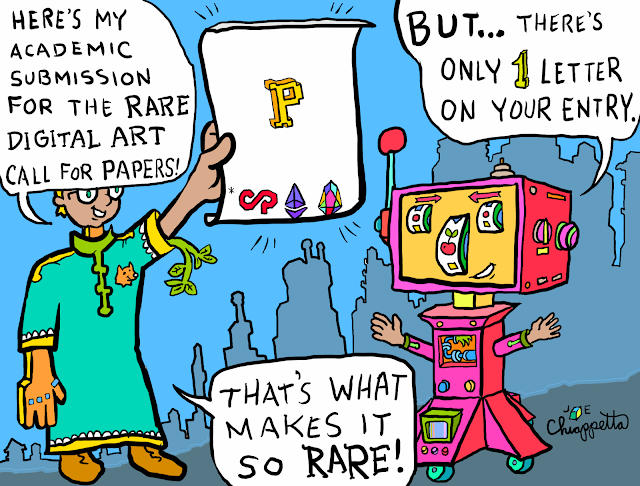
Rare Paper by Joe Chiappetta
Rare Paper by Joe Chiappetta is available as rare digital art on MakersPlace.
"Before I met you and only knew you through your cartoons, I thought you were just some goofy guy." That's what a talented business colleague said to me recently--in all seriousness.

While my comics can delve into the silly side of things, it might surprise a few folks to know that I am a deep thinker. Lately I have deliberated on what would be useful for artists and collectors to know about innovations in the art and blockchain space. Twelve considerations come to mind, and they all trace their roots back to a little digital creation called Bitcoin.

The fact that Bitcoin has been coded to exist in only 21 million units is highly relevant to artists and art collectors. Perhaps this is even more relevant than many in the art industry currently perceive. With Bitcoin came the advent of limited-supply cryptocurrency issuance; digital art tied to such currency is now able to be released in a limited supply as well.

Therefore, for the first time, a scarcity market can be imposed (or coded) into digital art, making it collectible. Ownership and rarity are verified on the blockchain. This ecosystem produces what we call "rare digital art." It is a movement that has grown by leaps and bounds since its inception a few years ago.

Nevertheless, there are facts about rare digital art that the buyer and seller must understand under the current technical structures in which it exists. What a person actually owns when they buy rare digital art is actually not the art. What they own--as in what can be traded--is a unique digital token on a blockchain. Such a token is often called a non-fungible token (NFT). Non-fungible means "unique." So that particular unique token is linked to a specific artwork. Therefore it is most accurate to say that the cryptographic token is what you own; the art represents the token's image.

Despite the above technical parameters, rare digital art still has widespread implications, including industry-disrupting innovations. It lands under the subcategory of Art as well as the subcategory of Cryptocurrency. As with anything new, it can be helpful to provide guidelines for rare digital artists and collectors joining in on this exciting game-changer in the art and finance ecosystems.

The following 12 recommendations and considerations are designed to shepherd artists and collectors through this revolutionary field that is rare digital art. I will list them as a quick overview and then go into more detail below.
  1. How To Choose A Good Blockchain For Rare Digital Art
  2. Operate On At Least 2 Blockchains
  3. Which Rare Digital Art Market Should You Operate On?
  4. Pricing Rare Digital Art With Variety
  5. How Many Rare Digital Art Editions Should Be Released?
  6. Artists Become Collectors
  7. Collectors Become Artists
  8. Buy Art That Includes The Artist's Signature
  9. Tell The Backstory
  10. Promote Your Art
  11. Beef Up Online Security
  12. Remember To Have Fun
The Mind Pour by Joe Chiappetta
The Mind Pour by Joe Chiappetta is available as rare digital art on MakersPlace.

12 Tips for Artists & Collectors of Rare Digital Art


1. How To Choose A Good Blockchain For Rare Digital Art

More blockchains and cryptocurrencies are created each quarter. Therefore spend a few months doing your own research first. As blockchains for rare digital art go, Counterparty (which runs on top of Bitcoin) and then Ethereum have the longest track record of operating in this space. EOS, with pixEOS running on top of it, is well-positioned to become a serious contender, with many others vying for a top spot.

So which blockchain is best for rare digital art? I see Counterparty, Ethereum, and EOS/pixEOS as each having unique traits that others do not have. If only the 3 of them could merge into one super-chain. But that's not current reality. Here is a summary of where these blockchains are at right now:
  • Counterparty is old-school respected as a rare digital art pioneer, running on top of Bitcoin, yet with a smaller user base, and therefore lower in funding/development resources.
  • Ethereum has the most rare digital art markets, widely adopted, well funded, (usually) decent public image, yet slow to upgrade to faster transaction times. 
  • EOS has fast transaction times, no user transaction fees, a large user base, yet still in the process of perfecting how to manage/govern their global blockchain fairly.

With these assessments in mind, here are some further questions to consider when asking what to look for in a blockchain for rare digital art?
  1. What is the measurable value of this blockchain? Market capitalization data can help to determine this. In other words, how many units of this cryptocurrency exist, multiplied by the current price of one unit?
  2. How many daily users does the blockchain have?
  3. Is this blockchain easy to use?
  4. How fast are the transactions?
  5. What are the fees to issue art on that blockchain?
  6. What other use cases does this cryptocurrency have?
  7. Is it a global, well-distributed blockchain, or is it just one or two computers running the whole network?
  8. Who is on the team leading development and upkeep of this blockchain?
  9. Can you really see this blockchain thriving in 5 years... 10 years... and beyond?
  10. How long has the blockchain been used already to trade rare digital art?

2. Operate On At Least 2 Blockchains

Cryptocurrency is still new technology, somewhat unregulated, volatile in pricing structure, and the competition to be a stable and desirable blockchain is fierce. Therefore, as time permits, create and collect art on at least 2 different blockchains. Then all your eggs will not be in 1 basket.

3. Which Rare Digital Art Market Should You Operate On?

Unless you create your own blockchain or marketplace, you will need to release/collect art on an existing rare digital art marketplace. There are many sites out there to do this, but not all will survive the test of time. Once you narrow down which blockchain(s) you prefer, then select a marketplace site (or two) with these considerations in mind.
  1. How well does this marketplace promote itself and its artists?
  2. What is the onboarding process for new artists?
  3. How easy is it to list new high resolution art for sale?
  4. Can collectors easily resell rare digital art they own?
  5. Are the digital art images hosted in secure locations?
  6. What art data actually ends up on the blockchain?
  7. How does the site fund its operations?
  8. What percentage of each sale do I get?
  9. Do artists receive resale royalties on all secondary sales?
  10. Is it likely that this particular market/online gallery will still be here in a few years?
  11. Is a collector's collection available for viewing under one public Internet address?
  12. Do you like viewing your art on this platform?
  13. Are other artists on this marketplace allowed to put the whole site at risk by uploading illegal content?
  14. How big is the community for this marketplace?
  15. Is their community full of people you want to interact with?
  16. What is the site's strategy to onboard people new to cryptocurrency?
  17. Does the site contain affordable art, or are too many items overpriced?
  18. Is the team running the site wise and professional?
  19. Do artists and collectors get access to their platform metrics (page views, sales data, etc.)?
Keeping the previous section in mind, I would find a marketplace home on at least 2 different blockchains. No single person could (or should) try all the various markets in existence for rare digital art, but it should be noted that MakersPlace (on Ethereum) scores favorably on more of the above criteria than other sites I am familiar with. This is actually one of the main reasons that I currently collect the most art from MakersPlace over others. On the artist sales side, I've had the most success on MakersPlace, SuperRare, and Atomic Hub (on WAX). Book of Orbs has also produced pleasant results if you want to use Counterparty.

Cryptosketches and Cryptographics are two very unique rare digital art markets whose innovation-levels are still forces to be reckoned with. However they appear to be proof-of-concept markets that may not receive further upgrades. Naturally, there are other sites I have heard good things about. However, I have no experience using them so I will stick only to what I know. 

4. Pricing Rare Digital Art With Variety

Diversification is the key here. Your body of work should have a variety of pricing options, regardless of how well known you are. This includes some art with a fixed price, and some that is up for auction. This will help to capture collectors of all income levels, all spending preferences, and keep you from been seen as an inaccessible star.

Auctions: 
Some of your work should not have a fixed price on it; rather it should be up for auction. Let people bid on it and price discovery will be market-driven. If the bids are not as high as you'd like, you are not under any obligation to accept such bids. No bids may also be a sign that you need to market your work more effectively.

The auction option is appealing on a number of levels. It's for people who have a bargain hunting mentality. It's for patient collectors hoping you'll accept their price if no one else is bidding on your work. Where the auction option becomes an extra boost to the artist is when multiple collectors start bidding on your work, driving the price higher than imagined.

Fixed Pricing: 
Give a high price only to work that meets all 4 of these points:
  1. It is one of your very best pieces... like in your top 10 of all time.
  2. It took you more than 3 hours to create.
  3. It is an edition of only 1.
  4. You can reasonably imagine another person actually paying a high price for this digital item even though what the buyer is actually getting is ownership of unique cryptographic token.
Set low prices on pieces that you want a lot of people to collect. Imagine you just released a pack of stickers or collectible cards and you want many people to enjoy them.

5. How Many Rare Digital Art Editions Should Be Released?

This depends largely upon a few factors:
  1. How many people at a time do you want to be owners of this work? If you want a lot of people to own it, then price it low. If you want only 1 owner at a time, then the price should be higher since it is a more scarce edition of only 1.
  2. Do you want to keep 1 edition for yourself too?
  3. Do you want to give a few away as promotional freebies?
  4. Is selling high volume a priority? Then price lower and release more per edition.
  5. For those considering releasing in editions of more than 10, first ask yourself, "Are there really more than 10 people who will spend money on this non-material digital item I created?" 

6. Artists Become Collectors

You will think clearer and with a bigger market vision in mind when you step into the shoes of your counterpart. Being a collector and an artist for decades, I frequently ask myself a few questions:
  1. Would another person actually pay money for this thing I am creating? 
  2. How much would I pay to have this in my collection?
  3. How original is this creation?
  4. If I want to resell this to other collectors, would buyers be attracted to it?
  5. Would I want this in my collection even if it does not increase in monetary value?
These collector considerations help me to push the boundaries of quality higher, and compel me not to release something that isn't ready for the market yet. Therefore I do advise all artists to collect at least a few pieces as it will certainly expand market awareness.

7. Collectors Become Artists

Similar to the previous point, collectors will benefit from issuing their own original art on a platform they are thinking of buying art on because they will discover firsthand how well the ecosystem works with less risk to themselves. Even for collectors who do not consider themselves artists at all, they could still issue one good photograph that they took themselves. It might even lead to some surprise sales. 

As an artist/collector, out of gratitude and curiosity, I typically look at the account of who bought my work. If I see anything in their collection that I want, I would happily make an offer on it. Moreover, a collector who issues their own art too has more trading leverage. An artist/collector can always trade their own art for another artist's work and thus minimize collecting expenses.

8. Buy Art That Includes The Artist's Signature

In a digital age, copying and pasting is easy. So art that is issued with the artist's signature incorporated into the art is somewhat less likely to be falsely attributed to another creator. Yes, the blockchain can record all this, but not everyone will go and explore the blockchain. Therefore keep an eye out for signed artwork.

In fact, as a collector, the artist's signature is one of the things I often look for when deciding to make the purchase or not. Mind you, I am not saying signatures must be mandatory. Indeed, on occasion I have bought art without signatures because it was clear that the art was from the ascribed artist since I follow them on social media. Yet a signature is useful when I have no context or relationship with the artist and I just want to make sure I am buying work properly attributed in the actual image.

On the creator side of things, having my signature on my art is important also because people will copy art and share it in various places--often without my permission. Sometimes they credit me in captions, but sometimes they don't. So having my signature on the art (written large enough to be readable even on mobile devices) helps to establish who did what.

9. Tell The Backstory

Pay careful attention to the art description. Part of the appeal of art is not just the actual art, but also the story behind the art. Artists should succinctly tell the tale of how the art came about, and/or elaborate on what the themes are. This can be done in a few sentences or a few paragraphs if needed.

If the art looks good, and the price looks good, my final decision on whether or not I buy art comes down to what the artist says. In fact, if an artist says nothing about the art, I don't buy it. For me it is a red flag for 3 possible reasons:
  1. The art may not be theirs.
  2. The art is shallow.
  3. They are dropping art frantically all over the internet, desperate for a quick sale, and have no care to cultivate a professional relationships with their collectors or the community market that they participate in.
Moreover, collectors can, and should add to this story. They can publicize why they decided to collect the art. Such details add to the experiential nature of the art world, and increase the legend behind a particular piece of art.

10. Promote Your Art

Art typically does not sell itself. The art market is highly saturated with talented creators. So diligent marketing is needed if you want to make consistent sales. Regardless of whether you are an artist or collector, nothing increases awareness and potential value quite like artists, and especially collectors talking about their art, sharing it, telling the backstory of it, getting the art in exhibits, and being active in a few relevant communities.

11. Beef Up Online Security

Since cryptocurrency can be exchanged for local currency through certain providers, in addition to attracting sincere professionals, it also attracts thieves and scammers. Therefore creators and collectors in this space need to use best practices when it comes to online crypto-related security. This will take time researching the latest tips, and it will also take vigilance to put them into practice.

12. Remember To Have Fun

We are talking about art and the collectible cryptocurrencies tied to it. This is not brain surgery or bomb diffusion. So lighten up and have some fun. It's about participating in the art experience along with this crazy crypto-ecosystem that is international, fast (usually), entertaining, paradigm-shifting, full of potential economic opportunities, and pleasing to the eye of the beholder.

Anniversary Dinner Date with My Wife by Joe Chiappetta
Anniversary Dinner Date with My Wife by Joe Chiappetta is available as rare digital art on MakersPlace

I hope these guidelines help you navigate the wonders of art linked to the blockchain. When diving into the deep and dynamic waters of rare digital art, you will do well to keep these elements in mind. As we shape this new frontier together, I also pray that you will enjoy the ride at least as much as I have!

Joe Chiappetta
Rare Digital Art Ownership Visualization

Rare Digital Art Ownership Visualization by Joe Chiappetta is available on MakersPlace
Rare Digital Art Ownership Visualization by Joe Chiappetta is available on MakersPlace

In understanding any new concept, it often helps to provide visuals. This is definitely the case with rare digital art. As a new ecosystem to release, catalog, sell and collect digital art, the growing field of rare digital art is fascinating for a number of reasons. For the first time ever, digital art can be coded to be entirely rare, sales could happen instantly and internationally through new monetary systems, royalties for secondary art sales can be built right into the market, the art can be sold for a fixed price or auctioned, artists can issue super-rare editions of only 1 or limited-editions such as 1 of 10. Mind you, I am only mentioning just a few of rare digital art's exciting features.

To illustrate what actually goes on when a person owns rare digital art, I have drawn up an imaginary universe where digital concepts are as tangible as the toes on your feet. Art collectors can buy this particular piece of rare digital art on the MakersPlace marketplace. It is a comical drawing that depicts a world lined with chains of data held in sequential blocks. That's where we get the term "blockchain." When someone buys rare digital art, they are actually buying a unit of cryptocurrency. Their account on the blockchain gives them a private key whereby only they can sell that crypto if they find a buyer. All this is packaged in an orderly and cryptographic manner on the blockchain. These blocks of ownership data are uniquely linked together so that the order and the data cannot be changed. Therefore the data on this blockchain has a decent semblance of permanence.

Is Art Really On the Blockchain?

While important data about art is permanently on the blockchain, what about the actual art's permanence? The art on the blockchain is a different, yet completely related story. In most cases, the actual art image is (gulp) not hosted on the blockchain. Rather the art is usually hosted the way most digital images are hosted: on a file hosting device called a server or multiple servers in physical locations, with the image being delivered (or "served") when someone on the Internet goes to a particular website (or image-enabled blockchain wallet). Therefore the art is as permanent as the Internet, the blockchain that holds the art data, and the servers that host the actual image.

With rare digital art, while the image does not truly reside on the blockchain, it's file name and web address are coded to be linked to a particular blockchain. So we can enjoy a little irony in the fact that art on the blockchain--in most cases--is not actually on the blockchain. Yet the art data, ownership and link to the art are on the blockchain.

Is Rare Digital Art Actually Rare?

While we are on the subject of irony, there is one more big one to cover. In the case of rare digital art, the art is... uh... not actually rare. In most cases, the art image is announced and uploaded to at least a few social media sites, plus the artist's blog, and then people share it over and over again on social media. Servers deliver the image to everyone viewing the art on the marketplace. So copies of the art are all over the place. Nothing rare about that. Yet as discussed in the previous section, all that doesn't matter--not one bit. What is rare is the crypto token that the art collector buys. That token cannot be copied, thanks to cryptography. This is where rarity comes in. When a collector buys rare digital art, it is a statement of value. It says "this art is so valuable, that I want to be on record as its owner so I can show it off in my collection, or sell it as I see fit, and I will do it all through the only economic vehicle that represents that art: its cryptocurrency token."

It is on top of these slightly ironic cybernetic rails of truth that art and tech pioneers started rolling out this new generation of artwork. We call it new, yet this was going on as early as 2014 in small groundbreaking circles. Little did people know that history was being made, and a whole industry would rise up from these humble and virtual beginnings. Yet here we are... making history... making art (kind of) on the blockchain. It seems only fitting then, since there have been movements of impressionism, cubism, futurism, and now... there is blockchainism.

So in making such a history, writers have to write about it. Artists have to make art about it. In the case of this rare digital art, the story needs to be told--or better yet shown--regarding what a person actually owns when they purchase rare digital art. What is owned? In short, it boils down to a few blunt facts:

The Short, Blunt Answer: What Do I Own When I Buy Rare Digital Art?


  • It's nothing you can touch.
  • Your purchase helps fuel a crypto crazy creative market ecosystem.
  • You bought into a crazy risk with the potential for crazy rewards that can just as easily drop to zero in value or go sky high.
  • You own cryptocurrency with a pretty face.
  • A unique crypto token is what you own; the art is what you see.
If any of this appeals to you, then we are probably destined to be friends. So all aboard the rare digital art train!

Joe Chiappetta


Global Art Market Data and Its Relation to Rare Digital Art

Big Appetite for Nuts by Joe Chiappetta
This rare digital art, which can be purchased on MakersPlace, is titled "Big Appetite for Nuts."

Perhaps you can guess why this crypto art has such a title? As a long time cartoonist, it is hard to resist making lighthearted jokes about the art experience. Such things can be seen in this satirical comic about the art market. It is a cartoon also influenced by my real life appreciation for nuts. I eat them every day.

While poking fun at the art market is pretty easy, this sector is actually no laughing matter; it's big business. Gratefully, data about art appears to be becoming more and more user-friendly. Artist industry professionals should take note of this, as relevant data can help guide business plans toward the appropriate opportunities.

One fine example comes from a recent 408 page survey using data and research from Dr. Clare McAndrew of Arts Economics along with an international art fair producer as well as an investment banking company. Here is what I got out of their collaborative efforts, known as the Art Basel and UBS Global Art Market Report, released in 2019 but covering data from 2018.
  1. Art market had just over $67 billion in annual sales.
  2. Just under 40 million different art transactions occurred.
  3. More millennials are buying art, especially those of high net worth.
  4. Countries where the largest total art sales happen are USA, UK, and China, in that order.
  5. Online art market made up 9% of all art sales. This level of digital disruption is considered low.
  6. The number 1 challenge in the art industry is finding new clients.
  7. The number 1 challenge for online art companies is increased competition from other online companies.
  8. On the auction side, Christie's hosted 88 online-only sales generating $86.4 million.
  9. An impressive 41% of new buyers to Christie's came from online.
  10. Male artists continue to dominate top sales and representation by major galleries and exhibitions.
  11. The report has a 3-page section on blockchain technology and cryptocurrency in the art market, plus it is covered briefly in a summary section. While not mentioned specifically by name, the article takes an unenthusiastic view of rare digital art on page 295: "A key issue in the tokenization of art, on- or offline, remains the lack of demand for the concept, which alongside management and other fees, will likely stall any mainstream interest for the time being."
  12. The mainstream art industry is cautiously warming up (somewhat) to using blockchain to possibly track the provenance of artwork. However there are many barriers that still need to be worked out, and blockchain providence providers appear to be competing with each other, creating unclear standard practices while not completely solving core issues (such as how to deal with errors on an unchangeable blockchain).
  13. The report gathered data from a variety of sources through many partners. It is unclear whether rare digital art market data was included in the research.
There are countless other observations that can be captured from this report. Yet the above is what stood out to me. Since much of my professional arts work today involves activity in the rare digital art field, and since the specifics of rare digital art analysis is largely missing from this mainstream study, it is necessary to take this topic a little further.

Currently I have issued rare digital art on 8 different marketplaces using 2 different blockchains (Bitcoin/Counterparty and Ethereum). There are many more rare digital art marketplaces than these. In fact, the number of additional rare digital art marketplaces keeps growing and it is difficult to keep track of them all.

Moreover, there currently is no up-to-date comprehensive list of where all these active markets are located. Some launched and are doing great (like many that I am on). Some tried to launch but never did. Others launched yet became inactive. And more are on the way. There are even tools now available (Pixura) where anyone without coding knowledge can now make their own rare digital art marketplace on the Ethereum blockchain. Therefore, let's take the mainstream survey findings and combined them with my own experience to come up with the following additional conclusions. 

Rare Digital Art Conclusions

  1. On the one hand, the rapidly increasing number of rare digital art markets means easier entry for artists wanting in on this unique market opportunity. 
  2. On the other hand, just like in the physical art market, this increase in rare digital art markets means that the supply of rare digital art will grow faster than demand.
  3. With supply being greater than demand, the majority of sale prices must be set lower to remain competitive. This means that it is a buyer's market. Art buying collectors should take note, as many bargains for high quality rare digital art are readily available.
  4. The rare digital art marketplaces who innovate and are great at communicating that innovation to the world (as in marketing) will be better positioned to survive and thrive. The gamification of art collecting and creating will drive future growth.
  5. Research on rare digital art markets could be beneficial to this sector's maturity, and help paint a more accurate picture of the art market as a whole. Since the sales figures and unique collector wallet addresses are all on publicly accessible blockchains, this data should be somewhat easier to compile.
  6. Rare digital art markets should form some sort of professional association to leverage shared resources and collaborate when strategic.
  7. Barriers to entry for women in rare digital art are much less evident compared to traditional art markets.
  8. Rare digital art marketplaces as well as their artists should divide their work week into 3 equal portions: 
    1. Making art
    2. Marketing art
    3. Educating art fans, potential and existing collectors, and tech savvy gamers on how and why to tap into this new market
Happy making, marketing, and educating to you!

Joe Chiappetta

Rise of Crypto-Art: 3 Opportunities for Artists on the Blockchain

Blockchain Bonnet art by Joe Chiappetta
Blockchain Bonnet by Joe Chiappetta is available as rare digital art on the SuperRare marketplace.

An Introductory Crypto-Art Article by Joe Chiappetta of Silly Daddy Comics

An overview of opportunities for artists on the blockchain are covered here, including rare digital art, crypto community graffiti, and online crypto social meritocracy.

It’s a pretty interesting time to be alive. Especially as an artist, I have seen rapid opportunities opening up for creative people. This has been largely due to advances in cryptocurrency, blockchain technology, and high speed mobile internet. With new technology often comes new terminology, methodology, and of course, opportunity. Such is the case with a wide classification of artwork known as crypto-art, which can be very loosely defined as artwork having something to do with cryptocurrency. 

All Quiet on the Bitcoin Front by Joe Chiappetta is mixed media and collage on paper, scanned and made available as rare digital art on MakersPlace
All Quiet on the Bitcoin Front by Joe Chiappetta is mixed media on paper, available as rare digital art on MakersPlace
Of course, the broad category of crypto-art includes physical artworks where the subject matter has to do with cryptocurrency, such as a tangible painting on canvas featuring a Bitcoin logo. In fact, such artworks are probably the first types of modern crypto-art. Yet this article has more to do with a newer phase of crypto-art: specifically digital art that is powered by blockchain technology.
Squiggly Rare Silly Chain by Joe Chiappetta
Squiggly Rare Silly Chain by Joe Chiappetta is rare digital art available on the MakersPlace marketplace.
Indeed, cryptocurrency and the mobile web are opening up the art world in unforeseen ways. Three new categories for an artist are now available... where previously there was nothing in terms of opportunity. This crypto-art article for beginners is focused solely on existing opportunities rather than resources that will soon be available. To be even more specific, in this primer I’m talking about current ways for digital artists to increase their exposure and earn more income from their digital artwork through new developments in cryptocurrency. Opportunities covered here include the following:
  1. Rare Digital Art making
  2. Rare Digital Art collecting
  3. Crypto Social Networks
There are actually more than 3 categories of opportunity now available, but the opportunities that I chose to highlight in this crypto-art article are in their infancy yet have large growth potential, plus they are widely available now to every artist with high-speed internet and a computer.
Crypto Bridge of Wisdom by Joe Chiappetta, available as rare digital art on SuperRare
DISCLAIMER
While I absolutely believe that this is a time of incredible and unprecedented opportunity for artists because of cryptocurrency developments, I must also add a disclaimer. Cryptocurrency is fairly new technology, somewhat unregulated, yet subject to certain tax laws and often volatile in its US Dollar equivalent highs and lows. In other words, if you do get into this field and start earning a lot, definitely consult a tax professional and know that there’s a lot of price fluctuation in the cryptocurrency market. Moreover, if you’re a risk taker, slightly tech savvy, willing to learn the tax implications, and not faint of heart, pay close attention to developments in this space, and perhaps even test the waters.

RARE DIGITAL ART or CRYPTO-COLLECTIBLES

The first and second opportunity for artists that has become new through cryptocurrency would be in the category of rare digital art: making it as well as collecting it. This category is also known as crypto-collectibles, or even digital collectibles. I personally prefer the term rare digital art, but this field is still so new, that no one really knows which term will stand out above the rest.
Payment Playground by Joe Chiappetta
Payment Playground is a blockchain card by Joe Chiappetta available on Book of Orbs in the CrystalsCraft Collection
The rare digital art industry is comprised of limited edition digital artworks that are each attached to a unique cryptographic token--also known as a cryptocurrency. A record of who owns this token and its attached art is readily available on a specific blockchain. Cryptocurrency runs on a "chain" of typically unalterable data, grouped in sequential "blocks." That's where the term blockchain comes from.

Often for those first hearing about the concept of rare digital art, an important question comes up. "Why would anyone want to spend money to own digital art when anyone can just copy the artwork file for free from the Internet to their own computer?" The answer is just as simple. Indeed, some will simply copy the file from the Internet. Yet certain collectors want more. These collectors will want to own the digital art that was personally issued directly by the artist in verifiably limited quantities. Blockchain has made this possible, and collectors are already doing exactly that. Moreover, many of these collectors choose to show off their collections to the public. Again, blockchain has made ownership of digital goods a new reality.

As a quick reference, here is a bulleted list that answers this common question:

Why Own Rare Digital Art When I Can Copy It for Free?

  • Prestige of Ownership
  • Collectible
  • Tradable
  • Portable
  • Curation Statement
  • Pioneering
  • Patronage
  • Safe Crypto Use-Case
Another concept to keep in mind is that there are many different blockchains that have been created. In fact there are well over 2,000 separate blockchains, yet many of them will amount to nothing special. CoinMarketCap, a site that lists key metrics on most cryptocurrencies, currently shows that there are at least 2,070 different cryptocurrencies.

Gratefully we can just focus now on the main blockchains that are in the widest use today to release and sell art directly on the blockchain. Presently there are only a handful. The blockchains that are currently in very wide usage to issue rare digital art include the Bitcoin blockchain (through an add-on crypto-data layer called Counterparty), and the Ethereum blockchain.

Since blockchain data can't be easily altered, and the data is verifiable by anyone, digital scarcity is now a real option for any piece of digital artwork. This means that digital art can now be issued in limited editions and collected for its level of rarity on the blockchain! Such collectible art is packaged in at least two different forms: (1) rare digital game items and (2) independent rare digital artwork.
  1. Rare Digital Game Items: This refers to various unique digital game items that interact and function as game pieces within a larger gaming ecosystem. 
    Heavenly Shepherd blockchain card playable in Spells of Genesis game
    Heavenly Shepherd blockchain card playable in Spells of Genesis mobile game
    One fine
     example would be the Spells of Genesis blockchain cards that are playable in their online game and tradeable on the blockchain. Incidentally, EverdreamSoft, the Swiss company that makes this cool game and issues its blockchain cards, holds the distinct honor of being one of the earliest to ever issue rare digital art.
  2. Independent Rare Digital Artwork: This refers to stand-alone, limited edition digital art pieces, both as static images as well as animated artworks.
CrystalsCraft Collection on Book of Orbs marketplace contains many Joe Chiappetta blockchain cards
CrystalsCraft Collection (launched March 2018) on Book of Orbs marketplace contains many Joe Chiappetta blockchain cards.
I have sold an incredible amount of my comics in the rare digital art marketplace. Naturally, I look forward to issuing more of my art there, as well as other key places. Many markets already exist out there for rare digital art, additionally known as non-fungible tokens (but I sure hope that odd, techie name referring to the art's non-interchangeable and unique nature doesn't stick). 
Joe Chiappetta rare digital art store on the MakersPlace market
Markets that I favor for issuing and also collecting rare digital art (because I personally use these particular markets) are many and varied, probably because I am pretty prolific. Therefore I like to diversify, having my art on a number of markets, based on where I think the art will sell the best. These crypto-collectible markets include:
Street sign art by Joe Chiappetta pointing the way to crypto-collectible marketplaces
Street sign illustration by Joe Chiappetta pointing the way to some of the many crypto-collectible marketplaces
There are many additional rare digital art markets, with new ones launching every quarter. I suppose no one person--other than a die-hard crypto-art researcher--could cover them all thoroughly. The markets that I use are working for me and have a nice track record of professional accomplishment. Of course, as time and opportunity permits, I am open to trying additional markets.
The Collectible Vitalik is a vector drawing of Ethereum founder Vitalik Buterin, by Joe Chiappetta on CryptoSketches
As a specific market for minimalist rare digital art, CryptoSketches deserves a bit more attention because of its groundbreaking nature. When I say minimalist, I mean line drawings that take about 40 strokes or under to complete. It is the only site I know of currently where anyone can instantly make a minimalist drawing directly into the CryptoSketches drawing app and that art becomes a piece of finished rare digital art on the Ethereum blockchain within the hour (or as soon as the transaction is cleared on the Ethereum network). This means your art is available for sale with no human approval necessary--and in the same hour that you created it.

Artists will need much more Ethereum than usual to issue their art in this particular platform. On other Ethereum platforms it currently only costs a few cents to issue rare digital art. But on CryptoSketches, the transaction fee to issue rare digital art is currently between $3 and $6. My guess is that this is probably because there is way more data in a CryptoSketches smart contract since each drawing's vector data is contained in the transaction, making it more expensive to run that transaction through the Ethereum network. I think of these expense, high or low, as if they were postage costs to send my work to a global market. That expense also weeds out spam artists who would otherwise flood the market with junk.
Another nice feature of CryptoSketches is that when you view finished pieces in the market, a replay of the drawing process is automatically generated. Currently, this might only be viewable to those who have the MetaMask browser installed. If you do have MetaMask, see the drawing replay example here of my ETHmobile art.
These unique features make CryptoSketches first-in-class for being the only app (so far) for direct draw-to-market issuance of rare digital art that also includes a video replay of the creative process. I am going to rephrase these features because it is a huge innovation for the entire art world. Think about it; where else can any artist quickly draw digital art and in that same action, directly and immediately issue that art onto the market for sale as a one-of-a-kind piece of rare digital art?

Since this is a vector based app, the built-in video-redraw features also gives CryptoSketches that added bonus of being able to review the exact creative process for each piece of art issued on its marketplace. This video replay turns the art into more than a static image owned by a unique collector on the blockchain. That collector is also buying the exact artistic process. In other words, what the collector also owns is not just the finished art, but also the code that replays the lines that made the art. How cool is that?

Cryptographics, mentioned earlier as another fine market for rare digital art, is also groundbreaking in so many ways. It is a generative art site, meaning that artists go there to add (or generate) unpredictable elements of randomness to their art. Additionally on Cryptographics, one artist's work can even be combined automatically with another artists work. This creates new hybrid artworks, where all contributing artists get a portion of the hybrid art sale for each crypto-collectible generated.
Blockchain Kingdom is rare digital art by Joe Chiappetta available on Cryptographics marketplace
Blockchain Kingdom is rare digital art by Joe Chiappetta available on Cryptographics marketplace
While being one of the newest sites that I issue rare digital art through, Cryptographics has instantly earned my respect as one of the most innovative and useful tools that a visual artist could utilize in this ever-changing digital age. In fact, I even wrote a more in-depth review of Cryptographics after using it extensively.
Asset pack created by Joe Chiappetta on Cryptographics allows others to create crypto-art with Joe's art
Asset pack created by Joe Chiappetta on Cryptographics allows others to create crypto-art with Chiappetta's art.


CRYPTO SOCIAL NETWORKS

An additional new opportunity for artists is in online crypto social networks. Once example of this is the site Steemit. Therein, creators can post their art, not merely for "likes" that don’t transfer into value, but "likes" that transfer into earning cryptocurrency that can (possibly) have a real world financial value: some only in fractions of a penny, yet others in higher dollar amounts.
Steemit screenshot of Joe Chiappetta posts
Steemit screenshot of Joe Chiappetta posts shows upvote earnings in USD.
However keep in mind that for most people, these crypto-social media earnings will not be enough to live on, and I would guess that some of these sites will not thrive since the market could get flooded or just plain fickle. Remember MySpace? There are only so many social media sites a person can be active on at any given time.
Most of these crypto social networks could also be called crypto social meritocracies. I use the term "meritocracy" because on these sites, the more you contribute, in terms of time into the community and value-added to the community, the more your presence there often earns you a reputation score that in turn, earns you more cryptocurrency. In other words, this is artistic social activity and earnings based largely on what you do, not on race, social class, gender, or past accomplishments. These meritocracies measure what you contribute now for the community, usually in the form of content creation as well as thoughtful curation of other people’s creative work.
Keep in mind that each crypto social network usually mints its own unique cryptocurrency. Some of these crypto coins are worth a decent amount if you accumulate enough of them over time. Yet others are worth almost nothing.

Summing up the category of Online Crypto Social Meritocracy, if you want to post your artwork on the web and earn some cryptocurrency while doing so, this is a definite way to do that. I am not saying that non-crypto-social media has no value. In fact I still use such sites for publicity, yet in a much reduced capacity because there is no financial compensation for contributing to these sites.

Therefore, as an entrepreneur, I have to look at what gives the most value for my time. Many artists already post their work only on non-crypto sites like Facebook, Instagram, and Twitter, yet get absolutely no monetary compensation in return for their consistent contributions to these sites. Been there. Done that. Might as well move to where some compensation exists and start getting paid in crypto for our time on the site. Then in the process, we may also find a new tribe of like-minded, creative-crypto people.

Crypto-Art Conclusion

With all of these new categories of opportunity for digital artists, there is a bit of a learning curve to know how to access the full benefits of these new systems--or even where to start first. Yet artists are learners, risk takers, and observant people themselves. In time those who want to be part of this new crypto-art movement will learn the ins and outs as lifelong learners.
I hope this introductory article on how artists are migrating their business onto the blockchain for increased growth has stirred your curiosity--to say the least. In all my years as an artist I have never seen so much rapid development and economic opportunity for the creative mind. There is no way to tell how rapidly these markets will grow. Neither is there any way to determine which of the opportunities discussed here will be the most beneficial. Therefore, over time, perhaps look into each category. Test the crypto-waters, so to speak. As for me, I will be looking forward to these and probably many more art innovations as crypto-markets mature and increase in adoption. Hopefully, I will see you around the crypto-art universe too!
Joe Chiappetta
http://SillyDaddy.net