Site Navigation

Showing posts with label art market. Show all posts

Intersection of Art & Values: Video Interview

I was interviewed in June 2026 about art/comics, culture, business, values and more on Exploring the Vintage NFT Space with ZeroG!
It's a pretty wide, career-spanning discussion with much depth, laughs, tips, and something for everyone.

Digital Art History from a Silly Daddy, Star Chosen, and Old Pocket PC Perspective

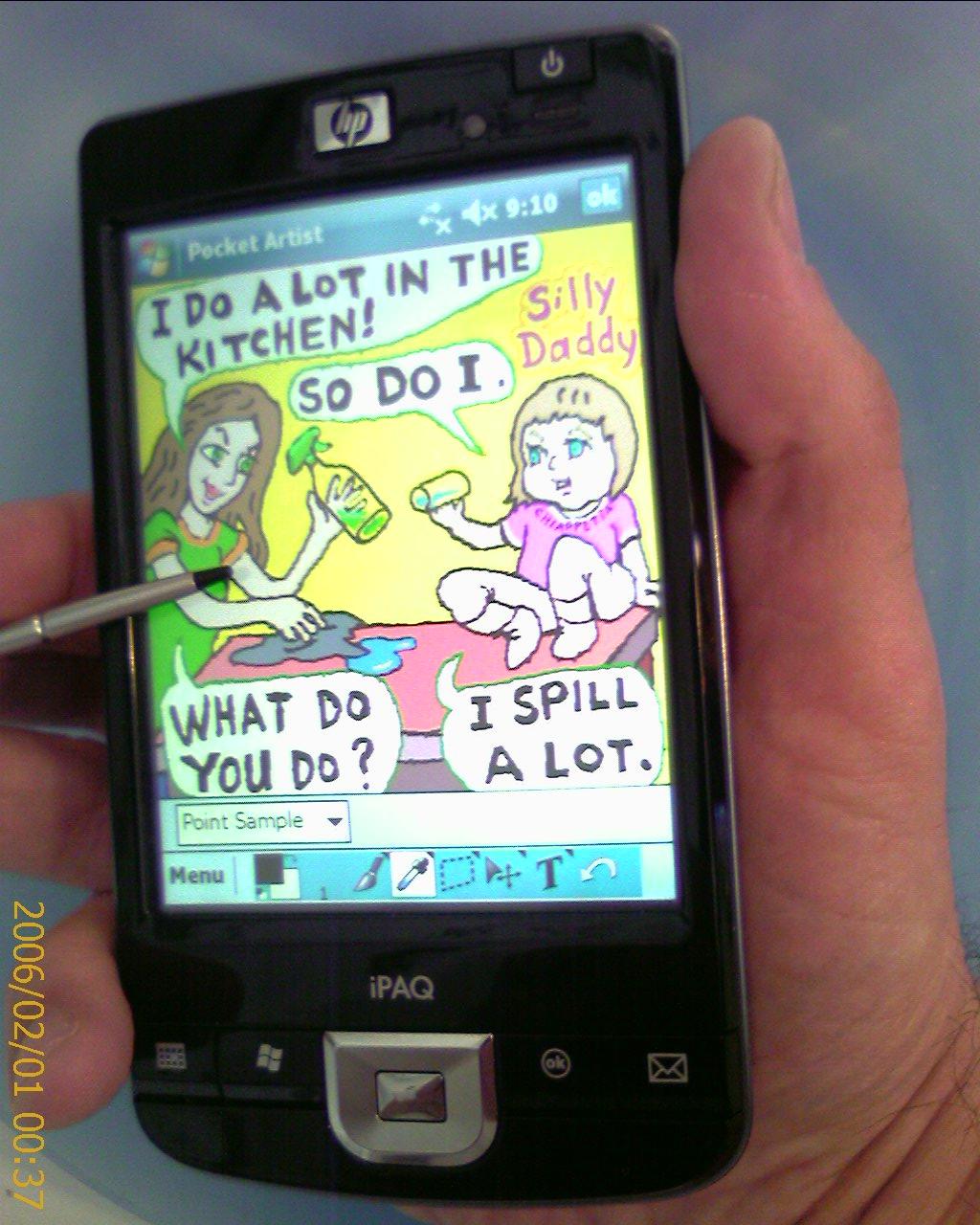
Joe Chiappetta draws Silly Daddy Comics on Pocket PC

Looking Back at the Past 25 years to Look Forward

Joe Chiappetta, 10/30/2025

Since the earliest days of Microsoft's Pocket PC in 2000 AD and later, the Pocket PC Phone, various art and drawing programs were available to load onto the Windows Mobile platform. While this operating system eventually lost out to the more famous ones of today (Android, Apple), with the right software back then, such devices--because they came with a great and resonsive stylus--were transformed into virtual, but miniature, art studios. Mind you these were really fully functional mini-drawing tablets decades before Apple Pencil and e-ink drawing tablets were available.

Yet are there any visual artists who consistently created viable bodies of artwork on such pocketable gadgets who are still active in digital art today? From the digitized word balloons of myself, a longtime cartoonist and digital artist, the answer is a resounding "Tap Stylus Here!"

Silly Daddy Forever comic book ordering page

While my long-running series, "Silly Daddy," contains comics drawn on all types of media, what's noteworthy to the digital art and mobile device community is that over 500 of those cartoons were created entirely on devices running Windows Mobile (as of 2009). After that milestone, I stopped counting. This creative utilization includes phones and personal digital assistant devices (PDAs). The last device of choice I used for Windows Pocket PC was the HP iPAQ 210 Enterprise Handheld, with its 4" screen. I drew, lettered and colored webcomics on that Pocket PC using Conduits Pocket Artist software (a mini version similar to Adobe Photoshop) or Vectorsoft Draw (a mini version similar to Adobe Illustrator).

Other Windows Mobile devices that I, for my "Silly Daddy" comics had used to create webcomics include the Samsung Omnia phone, the Verizon XV6700 (HTC) phone, the Verizon 6900 (HTC Touch), and from back in 2002, the die-hard Compaq iPAQ 3955.

The comics created entirely on mobile phones even spawned their own art subcategory: "telephomics." I do warn however, that when artists aren't using an earpiece while making telephomics, they can expect the drawing process to be interrupted frequently if a lot of phone calls are coming in. Such is the lot with all-in-one devices.

Back in the day, I also used the word processing power of Microsoft's Word Mobile program, which came standard with the operating system, to write out story ideas and Silly Daddy dialog. I even used the Pocket PC in 2005 to start writing a large portion of a full length science fiction novel (finished 20 years later), but that's another story altogether... called "Star Chosen."

Star Chosen science fiction novel - book ordering page

What all this digital art retrospective has done for me is quite profound. I see how far technology has advanced in the past quarter century, yet also how much all is still the same. Indeed, the handheld devices of today now do literally everything. But as for me, at heart, professionally, I am still somewhat like the patriarch Jacob. I have blessings which I am most grateful for, yet I believe I will receive even more. So I keep wrestling all night--not just with God as in the case of Jacob--but also with the ever-evolving digital art and publishing ecosystem. I won't let go until the blessings of being a digital creator are fully realized... or until the power goes out.


I invite you to read more about my digital art journey in a recent interview conducted by Digital Arts Blog. I'm so grateful to Cansu Waldron there for interviewing me about my long history in the arts! It was an absolute joy, privilege, and a blast to be featured there, as Digital Arts Blog has an impressive track record of crafting top-notch coverage of the digital art field! Cansu's insightful questions pulled so many unexpected and deep truths out of me--even career-enduring patterns I had never fully formulated until recently! We go into behind-the-scenes art-centric topics in a fun and fascinating way that I hope all can appreciate! You can read the interview at https://www.digitalartsblog.com/artist-spotlights/artist-interview-joe-chiappetta.
Why I Released 50 NFT Comics on zeroone

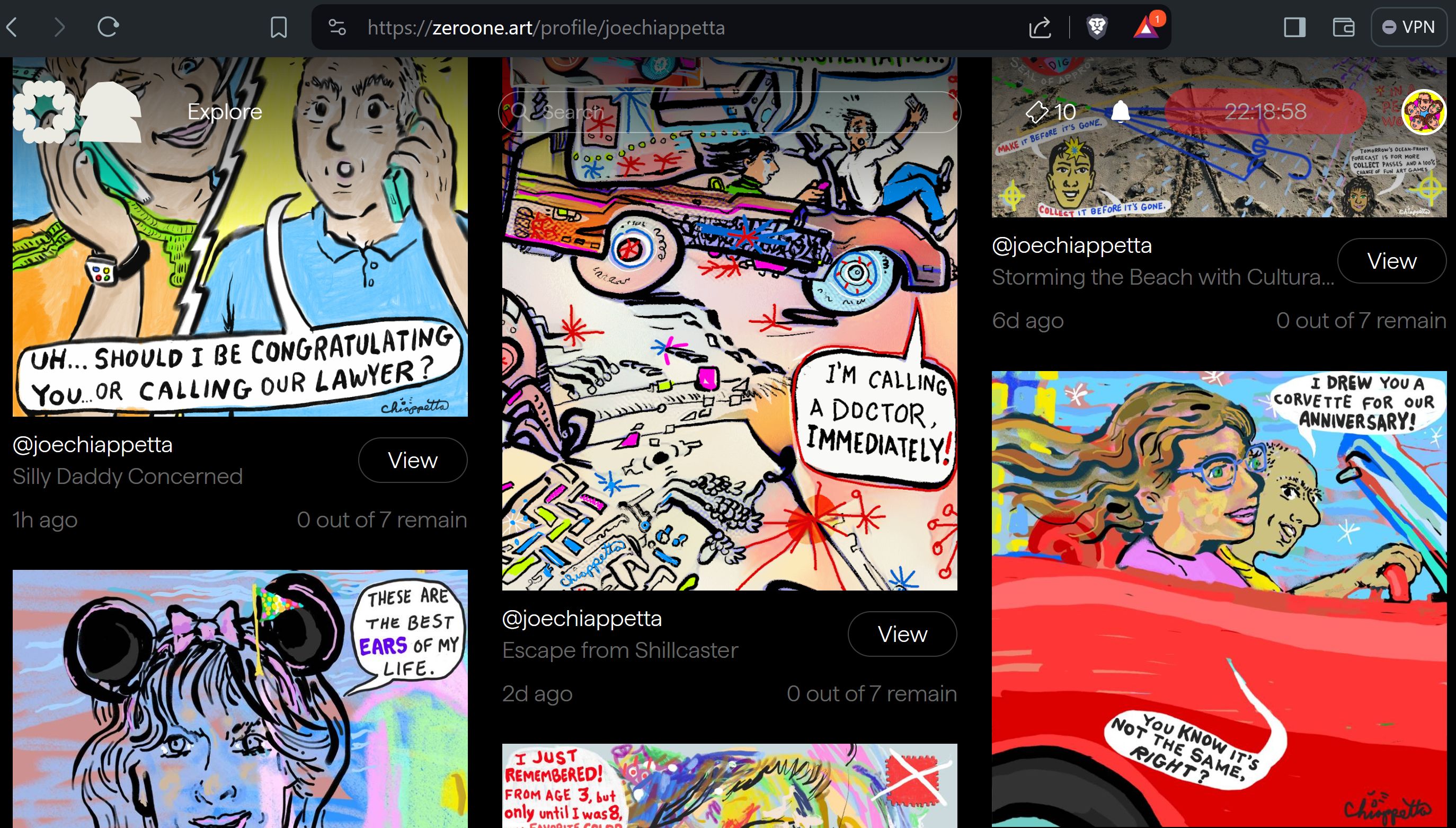
zeroone art profile page for Joe Chiappetta

Having spent the past 3 decades releasing art on the Internet, it would be an understatement to say that I have tried more than a few different art-related platforms over the years. For most of these websites, they offered timely tools for art marketplace access, publicity, sharing, and exploration. The art site I now prefer, "zeroone," has all that and so much more. As an incredibly visionary art site I have used almost exclusively for the past 10 months, zeroone also offers art ownership, gifting, and gamification. I could probably write pages of reasons why I appreciate the site, yet for the sake of brevity, here are the top 5 reasons I have spent nearly a year releasing 53 original comic NFTs on zeroone while also collecting nearly 500 art NFTs:

1. zeroone is THE place to collect original art NFTs where each person uses their own art as "currency" to gain collector passes. For every piece you release through zeroone's site, you can collect up to 10 artworks from other artists.

2. The community is typically un-snooty, easy-going, giving, and kind... which is refreshing to experience in the arts.

3. NFTs on a blockchain have historically been complicated to access, yet zeroone, running on the Avalanche blockchain, has made the NFT art collecting and releasing process ridiculously easy, quick, and free. This holds untapped potential for creative-minded people and institutions such as libraries, museums, schools, and galleries to start archiving their special collections on the blockchain where provenance is built into the platform.

4. While so much of the art world has a greed-mentality ingrained into its fabric, zeroone has a giving-mentality baked in. The only way to receive any art there is to give art.

5. zeroone is one of the rare places that has successfully turned NFT art-releasing and art-collecting into a game of sorts. It's fun and surprising to check the site and see if I'm in time to collect from one of my favorite artist's work there before all their editions run out--or before my collect passes run out. This game of art never seems to end--spurring me on to make and mint even more art in a festival of giving!

Play it with me and my son at https://zeroone.art/profile/joechiappetta and https://zeroone.art/profile/lukechiappetta

World's Fair of Rare Digital Art

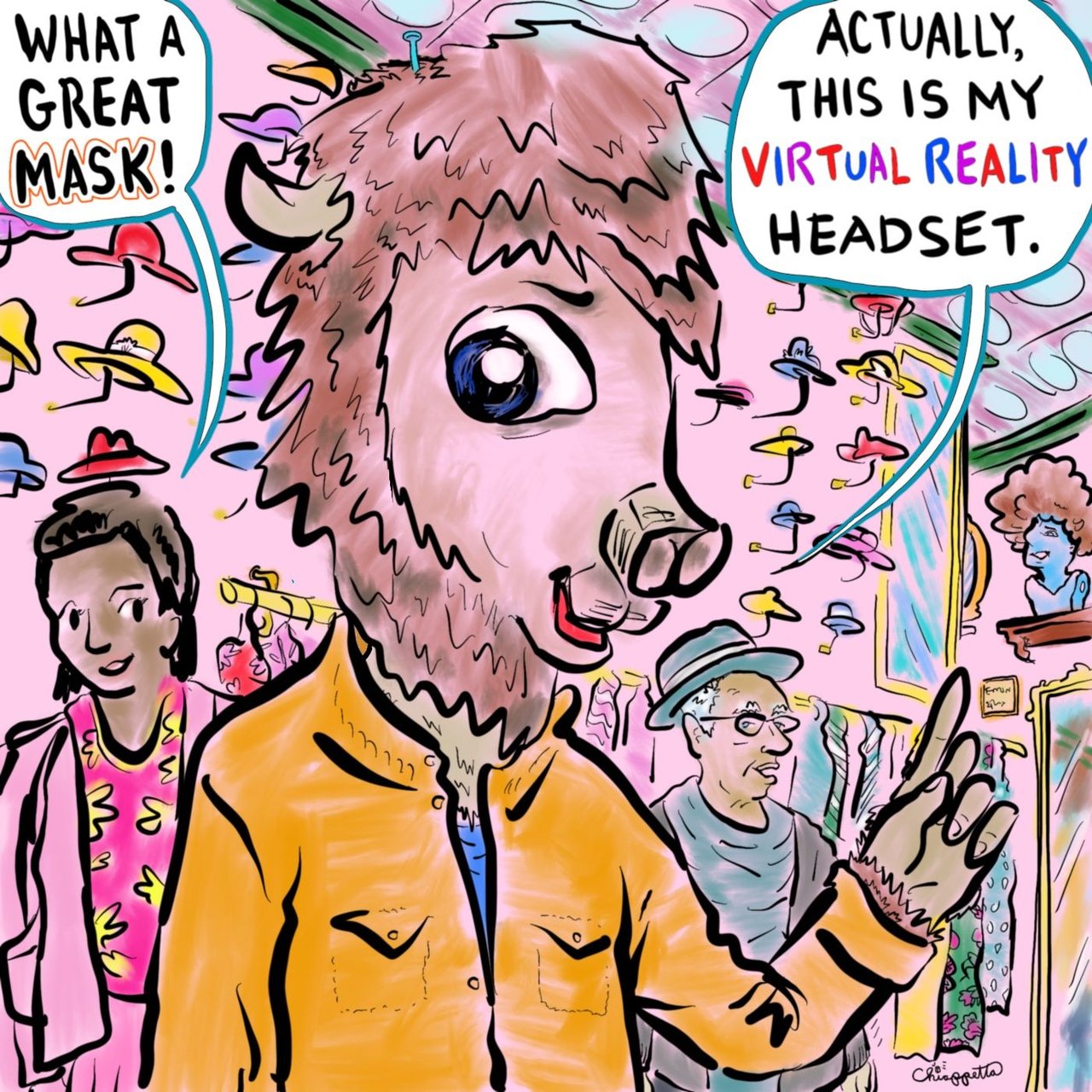
Where the Buffalo Browse is rare digital art by Joe Chiappetta
Where the Buffalo Browse is rare digital art by Joe Chiappetta, available on Atomic Hub Marketplace. While this cartoon pokes fun at virtual reality culture, behind the fun just might be an economic revival for the art industry--the likes of which has never been seen--at least not while wearing a buffalo helmet.

World's Fair of Rare Digital Art:

Digital Art Needs a Multidimensional Digital World

Joe Chiappetta, February 2021

When virtual reality (VR) becomes user-friendly, affordable, with universal technical standards integrated from online gallery to gallery, the art-loving world could see a revival more influential even than the Italian Renaissance. Indeed, everyone (with internet access) could witness this World's Fair of Online Art, open 24-7, poised to impress and built to buy/sell rare digital art as if you were floating through a game-like world because... well... because you would indeed be floating through a game-like world--virtually speaking. Such a place would have free admission for all, economic opportunity for all, and operate in 4 virtual dimensions of height, width, depth, and the dimension of "Wow, this is awesome!"

Of course, online 3-D digital worlds are nothing new, as any player of Minecraft or Second Life will tell you. Neither is cryptocurrency a new thing. In fact, all 3 of these systems have been operational for over 10 years. Yet what would happen if a 3-D digital world were well-integrated with digital art, community equality, and cryptocurrency? It could become the art industry's "killer app."
Silly Daddy VR Helmet is rare digital art by Joe Chiappetta
Silly Daddy VR Helmet is rare digital art by Joe Chiappetta, available on Atomic Hub
At 64 billion dollars for 2019, the global art market saw a decline in sales from the previous year. While 2020 statistics are not compiled yet, it is likely that this figure will be even lower. With fast transactions and borderless payment power, some are scrambling to declare cryptocurrency as the soon-to-be savior of a slumping global art market. 

However, the truth is at least a little more complex. Made possible by cryptocurrency, a small but excited number of people do collect rare digital art. But most in the art world still have no idea what such terms really mean.

What is rare digital art? It's online creative work tied to cryptocurrency that has been released in limited quantities, verifiable on a blockchain. For those in need of a refresher on what cryptocurrency is, think of it as coded internet money or credits released (usually) by entrepreneurs in specific predefined amounts. I should know; I have been researching and writing about this space for many years. In fact, I'm one of those rare digital art collectors. Many know that I am also a pretty prolific rare digital artist and educator in this space as well.

If you are just joining the rare digital art industry now, don't think you are late to the party. While rare digital art is 6 years old, the earliest pioneering developments from 2014 were not widely publicized and very slow in adoption (running on top of Bitcoin, often using Counterparty). Indeed, the first 4 years of rare digital art went by without much notice. Even now, the mainstream art world remains quite slow to completely jump on the bandwagon. So we are still in the very early days of rare digital art! For example, the Italian Renaissance lasted about 200 years, and some art historians find traces of the Renaissance roughly 100 years prior to its start through the work of Giotto. 

Whether the Italian Renaissance lasted 200 or 300 years, is not the point. Rather, it is significant that when a new movement starts, the early years of that movement are never as defined as historians make them out to be. Therefore if you are in rare digital art now, congratulations, fellow pioneer! You will be one of the early ones to help define and further shape it.

Since we are the early adopters, the question at hand is "Where do we go from here?" The first step is to soberly see where we really are now. The practice of buying rare digital art is only slowly being adopted by mainstream art collectors, and much of the rare digital art industry is dominated by speculators looking to make a quick profit flipping art. 

As an old-school physical collector turned rare digital art collector, I am not a flipper or speculator. In fact, of the many rare digital artworks in my collection, I rarely sell pieces from my collection. That is because I acquired the art in the first place because I wanted it for the fun of it. The art spoke to me in a unique way and simply made me happy. So if I can add such a piece to my collection, I will, and not worry about whether or not I can make money off of it later.
Zine Machine is rare digital art by Joe Chiappetta
Zine Machine is rare digital art by Joe Chiappetta, available on Atomic Hub.
By contrast, I do sell a nice amount of my own original artworks. That has been a practice of mine in the physical world (since the 1990s at comic book conventions) as well as in the digital world on rare digital art markets. While (literally by the grace of God) I have collectively sold hundreds of pieces of rare digital art on Ethereum Network, SuperRare, Atomic Hub, and Book of Orbs. I can't say the same for everyone. Indeed, the opposite is true; the majority of artists--despite their great talent--are not selling much.

Unlike myself, not everyone has the benefit of 4 decades experience in the arts as well as authoring one of the longest running autobiographical comics about family like I have with Silly Daddy Comics and Silly Daddy Zine. Most folks are just starting out as artists, or are really strapped for time working odd jobs and doing art on the side. Therefore, people can't be wasting time on markets where they may never sell anything. Everyone's time is valuable. So it is important, as we shape the rare digital art economy, that we build more opportunity in it--not just for the superstars, but for everyone.
Loyal Daddy is rare digital art by Joe Chiappetta
Loyal Daddy is rare digital art by Joe Chiappetta, available on Atomic Hub.
Despite the challenges of emerging artists struggling to make significant impact, artists are flocking to release new works on rare digital art markets in ever-increasing numbers. Naturally, due to the sad difference between supply and demand, as I alluded to previously, most of these artists will not sell anything there, and will soon leave the market discouraged. Some, in bitterness, may even spread a bad report about the true innovation going on in this still growing space, but don't be deceived; the best is still yet to come!

Next Steps for Rare Digital Art Markets

So what's the solution to increase demand for this kind of art? A higher quantity of serious art collectors will need a number of good reasons to jump into the rare digital art market. That's because the experience of collecting most digital art (rare or otherwise) is often--for lack of a better term--anticlimactic. It is hardly a social activity since collectors typically buy their art alone on their computers--with absolutely no fanfare. I know this because that is what I do as an art collector. 

Aside from the excitement of in-person rare digital art auctions, which are few and far between, why does collecting rare digital art hover on the sometimes anticlimactic side? It is actually a design problem. For most web sites selling rare digital art, the pieces are almost always offered in a visually dull grid layout. This is basically a 2-D catalog experience. Such design conventions have not changed since the mail order days which showcased department store catalogs of centuries gone by. That's not much different than scrolling through an Instagram art feed. Things really must change, and they can.

Gratefully, we have the technology to make those changes now. Online galleries who move to a virtual 3-D exhibit experience can be the ones who can stay relevant in an increasingly digital world.  As art-seeking and collecting becomes more of a game environment, more people will get excited about it.

The WAX community, and in particular the Atomic Hub Marketplace, is doing an incredible job at making 2-D rare digital art galleries fun, gamified, and incredibly user friendly. In fact, Atomic Hub has a "bundle" feature that allows collectors to buy multiple pieces of art in the same transaction. I liken it to the coolness and excitement of being a kid and buying a pack of trading cards. 

Digital Art Needs a Multidimensional Digital World by Joe Chiappetta is rare digital art available on MakersPlace
Digital Art Needs a Multidimensional Digital World by Joe Chiappetta. It's rare digital art available on Ethereum Network.
Another example of innovation is the unlockable content feature for owners of rare digital art. OpenSea and a growing number of other rare digital art markets have this feature. I used this feature to release my newest book, Silly Daddy Zine #1. Here's how it works: everyone can just see the cover of the book. But only those who buy it as rare digital art gain access to download the 50 page book. This unlockable download for owners is one of the most exciting new features in the industry, providing more incentive for further adoption.
Silly Daddy Zine 1 book cover by Joe Chiappetta
Silly Daddy Zine #1 is rare digital art and a 50-page book by Joe Chiappetta, available on Ethereum Network.

Looking to the future, the next bold step is to migrate the best of these current rare digital art markets, like OpenSea and Atomic Hub, onto one virtual 3-D world that is only somewhat similar to Minecraft, Decentraland, Cryptovoxels, or Somnium Space. I say "only somewhat similar to..." because none of those sites have all of the below essential features:

VR Art Gallery Essentials

  1. Exhibitors earn the rights to virtual 3-D land and wall space by purchasing affordable rare digital art in this world.
  2. The virtual 3-D land to have gallery space will always be cheap and not manipulated by early speculators trying to drive up the price of land.
  3. The virtual land borders keep expanding as more users exhibit in the space. Like the internet, where users can make an unlimited amount of new web pages, the same goes for wall and land space. More gets created as more is needed.
  4. Collectors can explore, exhibit their collections, and still buy and sell art all in a 3-D realm.
  5. The virtual 3-D gallery can be explored without a VR headset, plus users can buy and sell art without a headset too.
  6. The virtual 3-D gallery world has a 2-D auto-generated counterpart for those with slower technology.
  7. The 3-D world and its members have a code of conduct that adheres to the moral standard outlined in the FCC's guidelines and is a kid-friendly environment.
  8. Users can create individualized exhibit space right in the 3-D environment without any coding knowledge. All necessary virtual building materials are available for free.
  9. A few non-essential, yet more flashy premium gallery building materials are earned by those who buy a high volume of rare digital art, or complete defined and helpful tasks to advance the community.
  10. Users can teleport to any location in the "world" quickly and easily. These links work in-world and also as links on a regular website.
  11. Users can customize their own avatars.
  12. The gallery does not issue its own new cryptocurrency, but rather leverages existing and widely adopted currencies. The art and art experience is the product, not another alt-coin.
  13. Transactions to buy and sell art in the 3-D virtual environment can be done via credit card, PayPal, or existing crypto such as Bitcoin, Ethereum, EOS, and WAX. These cryptocurrencies are mentioned as they all have an existing and established track record of being used in current art markets. By default, financial actions on the site should be using blockchains that have no transaction fees to use the network.
  14. No sign-in is needed to view and explore this world.
  15. Open standards are used to foster as much continued development and international collaboration as possible. Perhaps Blockchain Game Alliance can help make this happen since they are a diverse professional coalition from a variety of blockchain and gaming platforms.
  16. The environment also has 3-D games that a user can play--kind of like walking through a carnival; there's a game booth, and next to it is an art booth, including a collaborative VR drawing space, like a VR version of Dada.art. Prizes won in the game booth can include rare digital art. As an added example, imagine being able to play a great rare digital art shooter game called Spells of Genesis in a multiplayer 3-D universe and receive game points, crypto, or rare digital art as your winnings!
  17. This VR cryptoart world should also have built-in user-to-user messaging (perhaps through secure chat), audio capabilities, and parental controls.
  18. Designed as an ever-expanding World's Fair of Online Art, collectors can seamlessly use their avatars to explore a 3-D version of contemporary high-end Expressionist art from various galleries on one virtual block, perhaps on a street called Emotional Way. Then they would turn a corner and walk down Budget-Buy Boulevard, where all rare digital art is no more expensive than a bottle of water.
  19. Such a site should also have a daily virtual newspaper, which aggregates relevant art news from this realm and sends it to members who subscribe. This would be things like how many new pieces of art were sold, created, who collects the most art, who releases the most art, who sells the most art, who has spent a lot of time on the site yet is not receiving many gallery visitors, who refers the most new users to the site through a referral code... kind of like a game leader board, but also designed to help everyone.
  20. Site should have the ability for creators to upload new rare digital art of their own creation to be displayed on exhibit space owned by the artist. The operators of the site would take a commission on these sales and artist would receive the bulk of the sales. The artist could also receive a percentage of the resale commission on all secondary market sales if made via blockchain through the platform.
While it must be acknowledged that some VR art galleries are already operational (and have been for years), most just feature artists creating VR experiences as an isolated piece, not other kinds of art, and not connected to a whole VR world. Additionally, few of these galleries use cryptocurrency, none of them are household names, and they're all fragmented realms. More importantly, none of the existing sites have even a fraction of the features numbered above. Yet this is what is needed for wide consumer adoption.

That's not to say that existing VR galleries are failing or prospering; the data on that is not easily available (or reliable). Yet like the rest of the art world, these sites are typically siloed, many requiring expensive hardware to view (while this same hardware will be obsolete in a few years), and most of the existing VR galleries are hustling to make an individual name for themselves. There's nothing wrong with hustling to self-promote, but much effort must also be spent on collaborating to build a unified virtual art fair experience.

Consider this analogy as the current state of VR art galleries: disconnected food trucks with delicious food, yet non-uniform procedures exist at random, hard to find parking lots, while what is really required is a cohesive international full service food court. A combination of the above-listed elements could create a very compelling art environment that would be unprecedented, and perhaps even become the "Ready Player One" artistic universe of tomorrow... yet live in our own time. It would inspire many repeat customers, delighted to explore a dynamic virtual art market in an exciting and gamified role as art collectors, art-seekers, and new art pioneers.

Joe Chiappetta
http://SillyDaddy.net

Art v Economy: Declaring a New Winner

Art v Economy is rare digital art by Joe Chiappetta
Art v Economy by Joe Chiappetta is rare digital art available on MakersPlace. The initial drawing started out as a still image drawn by Joe on the Dada.art online drawing community. He has drawn over 350 original digital drawings and paintings directly through the Dada.art online drawing tool.

Art v Economy: Declaring a New Winner

By Joe and Denise Chiappetta

A Southern California husband/wife team with the combined traits of being artist/author/collector draw up battle plans in a peaceful fight to create new opportunities for artists and art-lovers.

Let's start by stating the obvious before we move to something radical. The economy heavily influences art. Some creators, especially those who spend more time on the business side of art, might even say that the economy oppressively influences art. The pursuit of wealth and/or income in the arts reshapes art into a highly altered state. Most art we see today is not quite pure art; rather it is art under the intoxicating influence of the pressure to make money. In fact, too many artists find themselves ever-transitioning their under-funded careers based on what they think the market will eventually pay them for.

Of course, in the early stages of an artist’s life cycle, he or she often creates whatever they want. Yet, someone needs to pay the bills. Such artists eventually go from following that inner voice to following what they think will sell--hopefully without compromising “too many” of their principles. It’s a survival issue that, like it or not, heavily influences most artists who are not independently wealthy.

Can we also say the reverse is true: that art heavily influences the economy? Hardly. When was the last time you saw a painting that compelled you to forgive a debt owed to you? Try asking a banker that same question.

Art sales are certainly part of the economy, yet art almost never has a heavy influence on the mechanics of the economy itself. Sure, art can move people’s hearts for a time, and it should. Yet an artwork’s influence rarely scales from the heart to the pocketbook and on into the wallet of every practicing artist. The term “starving artist” is common for a reason.

Sadly, there is an all-too-easy way to prove this. As wonderful as art is, most restaurants will not let the average artist exchange a drawing as payment for their meal. Landlords will not accept a mural to satisfy the upcoming rent due. Moreover, it is well known that most artists do not make a sustained, sufficient living off of their art creations. Art school typically increases an artist’s debt: oftentimes, sadly, without increasing the likelihood of paid employment in the arts.

Why are such things true? It is a supply and demand issue. The economy historically does not have enough art demand to pay a living wage to even one-tenth of all the artists active today. For those keeping score--thus far--the economy wins. Artists lose, culture loses and therefore everyone loses. Thus the status quo marches on.

"Meet the new boss; same as the old boss." Pete Townshend wrote that classic lyric into The Who's hit song Won't Get Fooled Again back in 1971. Sadly, that statement keeps ringing true in way too many areas--including the art market. It was hoped, with the rise of cryptocurrency--which is revolutionizing money--that most artists could also benefit through a related innovation called "rare digital art." Without getting too technical, that's an emerging practice of releasing digital art paired to an unique cryptocurrency token that can be easily traded and authenticated instantly online. 

Yet rare digital art is already 5 years old, and most artists who use it have not experienced a significant lifestyle improvement due to this technology. To be clear, rare digital art is incredible technology and and growth opportunities exist in this field. In fact, our family has benefited from it significantly. However that is not the case for the majority of participating creative people. That's because no one (so far) has successfully merged an art community sharing mentality with a conscientious art collector's mentality while also making the process fun, social, fair, friendly, and economical.

Is there a solution to this issue? Yes, there is. Mind you, it is one that will take a heavy degree of coordination, but it can be done. Indeed, there is a way for artists to win, which in turn, means everybody who participates wins.

The steps required to create this new paradigm--where artwork has an extended socioeconomic reach--is multifaceted and off the beaten path. Getting there can happen as soon as most of the following challenges/opportunities/steps are fulfilled.

A Dozen Steps to Art Victory

  1. Create a symbiotic culture where gifting art is highly valued, thereby increasing the value of the art, the value of the community, and the value of the art-creating and art-acquiring experience.
  2. Incentivize the community to value commitment over popularity, and ensure that latecomers are not disadvantaged.
  3. Create a network where sharing and open collaboration are rewarded.
  4. To log all the art provenance data, use a publicly accessible decentralized blockchain that operates quickly, is user friendly to non-tech people, and also has 0 (or near 0) end-user fees to transact on the network.
  5. Bring in vendors and suppliers who accept art tokens as payment or discounts for their services.
  6. Transform art collectors into art stewards. These custodians of art can pay for the honor and public recognition of being custodians of particular pieces, yet the majority of sales commissions go back to the artist, with the whole community also getting a distributed cut of the action.
  7. Reward non-artists for measurable actions that advance this art community.
  8. Operate the community as a somewhat decentralized organization where roles are delegated to those who have proven their worth to the community, and the duration of each role is reassessed regularly.
  9. To guard against counterfeit art, build an online art creation tool that authenticates who created which art.
  10. Make this art creation tool collaborative, where artists have the option to collaborate on works together.
  11. Enable the art creation tool to issue a tradable token uniquely tied via blockchain to each piece created on the art tool, thereby giving market functionality to every piece created in the community.
  12. Structure the community in kindness as a blend of online and in-person interactions.
If all this sounds like it is too theoretical, it actually is not. At least one-third of these components are already in place in a rare digital art community called Dada.art, and the rest are in active development in that very same community. Think of DADA as an endless jazz session, yet for people who draw.

This twelve-step plan--in a nutshell--is to incentivize a nurturing creative original art ecosystem that benefits all participants while making the economic components of art less celebrated yet still important. In the Dada community, such a vision is increasingly called “The Invisible Economy.” Once all dozen of these steps are completed, we believe everyone will call it “progress.”

The current state of this world we all share is troubling, with a worldwide health crisis, a global economic crisis, as well as widespread political and racial unrest. However, we have been given the gift of advanced technology and a philosophy to structure a nurturing international ecosystem for the art community. Used wisely, it can rework the traditional landscape of both art and the economy, while building bridges of compassion and creativity across the borders of nations around the world.

Using these twelve steps, an online drawing platform that turns individual drawings into art conversations becomes supercharged into a functional force of hope, artistic equality, and even an art market revolution. Creators and art lovers will soon have the opportunity to create, share, influence, and extend the value of authenticated art as they practice their craft. A time for change beckons. Join us and be a part of it. In an epic race that has spanned for centuries, we plan to see you at the victory line: where art is finally declared the winner!

Art Gallery 70 Years in the Making: pixEOS

70 Years in the Making is rare digital art by Joe Chiappetta in pixEOS Gallery
"70 Years in the Making" is new rare digital art by Joe Chiappetta which depicts an oscilloscope from the 1950s. It is animation that provides a modern-day glimpse into our art history roots--70 years in the making, and is one of the many artworks available in the pixEOS Gallery.

I really enjoy exploring my artistic roots to understand who has come before us to pave the way. Recent research has led me to the 1950s in Cherokee, Iowa. It was there in the American Midwest that a widely talented man, Ben Laposky, created some of the earliest known electronic visual art. Ben used an oscilloscope, which is a device that turns voltage into moving lines of light. He recognized these patterns/designs as unique artworks, and called them "electrical compositions" as well as "electronic abstractions." Back then, the only way Laposky knew to potentially monetize his animated creations was to take black and white photos of his abstract designs and exhibit them. Ben was a mathematician, Purple Heart recipient, and remarkable pioneer in the arts.

The steady advancement of computers in the decades to come would entice more artists into the (literally electrifying) field of electronic arts, both analog and digital. Seventy years later, excitement and innovation continues to run high in the electronic arts, with no signs of slowing down. This is especially true in the 5 year old field of rare digital art.

Attention continues to increase for online digital art markets--made even more apparent by the March 2020 closing of all physical museums and galleries due to the spread of a worldwide disease. Despite these global health issues, art collectors remain active with a real appetite to collect blockchain-registered art. All made possible--of course--through electricity, these artworks are issued in limited editions and tied to cryptographic tech running in the background. Just as cryptography regulates Bitcoin in a verifiably limited supply, the same is true for artworks, hence the name rare digital art. Also known as non-fungible tokens (NFTs), art ownership, release dates, sales history, and artist authenticity are automated through global computer networks.

The technology to issue rare digital art keeps evolving. The latest in this evolution is the Grand pixEOS Art Gallery. Operational since March 25th, 2020, a few features of the pixEOS Gallery are worth highlighting.

1. Gallery transactions (buying/selling) are fast--like blazing fast. That can be attributed to the team being active in the industry for many years and the fact that the EOS blockchain, on which the gallery operates, is known for its speed.

2. The artists in the gallery are a widely diverse blend of international talent. Some have been "around the blockchain" for many years, some are longtime pro artists yet new to rare digital art, and some are emerging artists grateful to gain instant access to global sales potential for their creative works.

3. Art collectors buy the rare digital art using EOS tokens or PIXEOS tokens, depending on how the artist chooses to list for sale.

4. Each collector gets their own unique page to exhibit their prized possessions and/or resell them for a potential profit.

5. Each time an artist's work is resold (when the collector who buys the work sells it to another collector), the artist receives a percentage of these secondary sales automatically.

6. Artwork can be auctioned off or sold for a fixed price.

7. Simple and complex motion is often added by artists to their static original artworks, creating a new animated art marketplace. Using GIF format, animations are widely created and collected.

While it is unfortunate that legendary electronic art pioneers of decades-gone-by were not able to utilize this exciting new way to distribute, monetize, and collect electronic artwork, many remain grateful to be active in such a lively legacy that has become a digital art revolution. To the future... to the pixEOS Gallery!

pixEOS Gallery Live on EOS Mainnet

pixEOS Gallery screenshot with art by Joe Chiappetta and other artists

Many years ago, when the EOS blockchain was still just an unlaunched idea in active development, I wanted to assemble the right people together to create a rare digital art gallery on top of that promising new technology. In the course of this wild and entirely unpredictable journey I met a few others who had the same vision and we joined forces. Finally, after much prayer, planning, perseverance, and development, that fine art marketplace has become a reality that we now call The Grand pixEOS Art Gallery.

It has been a long, winding, and sometimes abstract-expressionist road, yet I know that this is really just the beginning of a paradigm shift in the art market! The gallery is now officially open for business as the first professional international digital art marketplace on the EOS blockchain. Art collectors can now collect their favorite pieces of rare digital art (also known as non-fungible tokens, NFTs), trade them, and participate in the future of art today!

I thank God for victorious moments like this, and for the blockchain and arts communities for being so patient and supportive of us!

Joe Chiappetta

The World's Fair of Online Art

Digital Art Needs a Multidimensional Digital World by Joe Chiappetta is rare digital art available on MakersPlace
Digital Art Needs a Multidimensional Digital World by Joe Chiappetta. It's rare digital art available on MakersPlace.

The article that originally appeared with this artwork has been heavily revised and updated here.

Rare Digital Art Ownership Visualization

Rare Digital Art Ownership Visualization by Joe Chiappetta is available on MakersPlace
Rare Digital Art Ownership Visualization by Joe Chiappetta is available on MakersPlace

In understanding any new concept, it often helps to provide visuals. This is definitely the case with rare digital art. As a new ecosystem to release, catalog, sell and collect digital art, the growing field of rare digital art is fascinating for a number of reasons. For the first time ever, digital art can be coded to be entirely rare, sales could happen instantly and internationally through new monetary systems, royalties for secondary art sales can be built right into the market, the art can be sold for a fixed price or auctioned, artists can issue super-rare editions of only 1 or limited-editions such as 1 of 10. Mind you, I am only mentioning just a few of rare digital art's exciting features.

To illustrate what actually goes on when a person owns rare digital art, I have drawn up an imaginary universe where digital concepts are as tangible as the toes on your feet. Art collectors can buy this particular piece of rare digital art on the MakersPlace marketplace. It is a comical drawing that depicts a world lined with chains of data held in sequential blocks. That's where we get the term "blockchain." When someone buys rare digital art, they are actually buying a unit of cryptocurrency. Their account on the blockchain gives them a private key whereby only they can sell that crypto if they find a buyer. All this is packaged in an orderly and cryptographic manner on the blockchain. These blocks of ownership data are uniquely linked together so that the order and the data cannot be changed. Therefore the data on this blockchain has a decent semblance of permanence.

Is Art Really On the Blockchain?

While important data about art is permanently on the blockchain, what about the actual art's permanence? The art on the blockchain is a different, yet completely related story. In most cases, the actual art image is (gulp) not hosted on the blockchain. Rather the art is usually hosted the way most digital images are hosted: on a file hosting device called a server or multiple servers in physical locations, with the image being delivered (or "served") when someone on the Internet goes to a particular website (or image-enabled blockchain wallet). Therefore the art is as permanent as the Internet, the blockchain that holds the art data, and the servers that host the actual image.

With rare digital art, while the image does not truly reside on the blockchain, it's file name and web address are coded to be linked to a particular blockchain. So we can enjoy a little irony in the fact that art on the blockchain--in most cases--is not actually on the blockchain. Yet the art data, ownership and link to the art are on the blockchain.

Is Rare Digital Art Actually Rare?

While we are on the subject of irony, there is one more big one to cover. In the case of rare digital art, the art is... uh... not actually rare. In most cases, the art image is announced and uploaded to at least a few social media sites, plus the artist's blog, and then people share it over and over again on social media. Servers deliver the image to everyone viewing the art on the marketplace. So copies of the art are all over the place. Nothing rare about that. Yet as discussed in the previous section, all that doesn't matter--not one bit. What is rare is the crypto token that the art collector buys. That token cannot be copied, thanks to cryptography. This is where rarity comes in. When a collector buys rare digital art, it is a statement of value. It says "this art is so valuable, that I want to be on record as its owner so I can show it off in my collection, or sell it as I see fit, and I will do it all through the only economic vehicle that represents that art: its cryptocurrency token."

It is on top of these slightly ironic cybernetic rails of truth that art and tech pioneers started rolling out this new generation of artwork. We call it new, yet this was going on as early as 2014 in small groundbreaking circles. Little did people know that history was being made, and a whole industry would rise up from these humble and virtual beginnings. Yet here we are... making history... making art (kind of) on the blockchain. It seems only fitting then, since there have been movements of impressionism, cubism, futurism, and now... there is blockchainism.

So in making such a history, writers have to write about it. Artists have to make art about it. In the case of this rare digital art, the story needs to be told--or better yet shown--regarding what a person actually owns when they purchase rare digital art. What is owned? In short, it boils down to a few blunt facts:

The Short, Blunt Answer: What Do I Own When I Buy Rare Digital Art?


  • It's nothing you can touch.
  • Your purchase helps fuel a crypto crazy creative market ecosystem.
  • You bought into a crazy risk with the potential for crazy rewards that can just as easily drop to zero in value or go sky high.
  • You own cryptocurrency with a pretty face.
  • A unique crypto token is what you own; the art is what you see.
If any of this appeals to you, then we are probably destined to be friends. So all aboard the rare digital art train!

Joe Chiappetta


Global Art Market Data and Its Relation to Rare Digital Art

Big Appetite for Nuts by Joe Chiappetta
This rare digital art, which can be purchased on MakersPlace, is titled "Big Appetite for Nuts."

Perhaps you can guess why this crypto art has such a title? As a long time cartoonist, it is hard to resist making lighthearted jokes about the art experience. Such things can be seen in this satirical comic about the art market. It is a cartoon also influenced by my real life appreciation for nuts. I eat them every day.

While poking fun at the art market is pretty easy, this sector is actually no laughing matter; it's big business. Gratefully, data about art appears to be becoming more and more user-friendly. Artist industry professionals should take note of this, as relevant data can help guide business plans toward the appropriate opportunities.

One fine example comes from a recent 408 page survey using data and research from Dr. Clare McAndrew of Arts Economics along with an international art fair producer as well as an investment banking company. Here is what I got out of their collaborative efforts, known as the Art Basel and UBS Global Art Market Report, released in 2019 but covering data from 2018.
  1. Art market had just over $67 billion in annual sales.
  2. Just under 40 million different art transactions occurred.
  3. More millennials are buying art, especially those of high net worth.
  4. Countries where the largest total art sales happen are USA, UK, and China, in that order.
  5. Online art market made up 9% of all art sales. This level of digital disruption is considered low.
  6. The number 1 challenge in the art industry is finding new clients.
  7. The number 1 challenge for online art companies is increased competition from other online companies.
  8. On the auction side, Christie's hosted 88 online-only sales generating $86.4 million.
  9. An impressive 41% of new buyers to Christie's came from online.
  10. Male artists continue to dominate top sales and representation by major galleries and exhibitions.
  11. The report has a 3-page section on blockchain technology and cryptocurrency in the art market, plus it is covered briefly in a summary section. While not mentioned specifically by name, the article takes an unenthusiastic view of rare digital art on page 295: "A key issue in the tokenization of art, on- or offline, remains the lack of demand for the concept, which alongside management and other fees, will likely stall any mainstream interest for the time being."
  12. The mainstream art industry is cautiously warming up (somewhat) to using blockchain to possibly track the provenance of artwork. However there are many barriers that still need to be worked out, and blockchain providence providers appear to be competing with each other, creating unclear standard practices while not completely solving core issues (such as how to deal with errors on an unchangeable blockchain).
  13. The report gathered data from a variety of sources through many partners. It is unclear whether rare digital art market data was included in the research.
There are countless other observations that can be captured from this report. Yet the above is what stood out to me. Since much of my professional arts work today involves activity in the rare digital art field, and since the specifics of rare digital art analysis is largely missing from this mainstream study, it is necessary to take this topic a little further.

Currently I have issued rare digital art on 8 different marketplaces using 2 different blockchains (Bitcoin/Counterparty and Ethereum). There are many more rare digital art marketplaces than these. In fact, the number of additional rare digital art marketplaces keeps growing and it is difficult to keep track of them all.

Moreover, there currently is no up-to-date comprehensive list of where all these active markets are located. Some launched and are doing great (like many that I am on). Some tried to launch but never did. Others launched yet became inactive. And more are on the way. There are even tools now available (Pixura) where anyone without coding knowledge can now make their own rare digital art marketplace on the Ethereum blockchain. Therefore, let's take the mainstream survey findings and combined them with my own experience to come up with the following additional conclusions. 

Rare Digital Art Conclusions

  1. On the one hand, the rapidly increasing number of rare digital art markets means easier entry for artists wanting in on this unique market opportunity. 
  2. On the other hand, just like in the physical art market, this increase in rare digital art markets means that the supply of rare digital art will grow faster than demand.
  3. With supply being greater than demand, the majority of sale prices must be set lower to remain competitive. This means that it is a buyer's market. Art buying collectors should take note, as many bargains for high quality rare digital art are readily available.
  4. The rare digital art marketplaces who innovate and are great at communicating that innovation to the world (as in marketing) will be better positioned to survive and thrive. The gamification of art collecting and creating will drive future growth.
  5. Research on rare digital art markets could be beneficial to this sector's maturity, and help paint a more accurate picture of the art market as a whole. Since the sales figures and unique collector wallet addresses are all on publicly accessible blockchains, this data should be somewhat easier to compile.
  6. Rare digital art markets should form some sort of professional association to leverage shared resources and collaborate when strategic.
  7. Barriers to entry for women in rare digital art are much less evident compared to traditional art markets.
  8. Rare digital art marketplaces as well as their artists should divide their work week into 3 equal portions: 
    1. Making art
    2. Marketing art
    3. Educating art fans, potential and existing collectors, and tech savvy gamers on how and why to tap into this new market
Happy making, marketing, and educating to you!

Joe Chiappetta